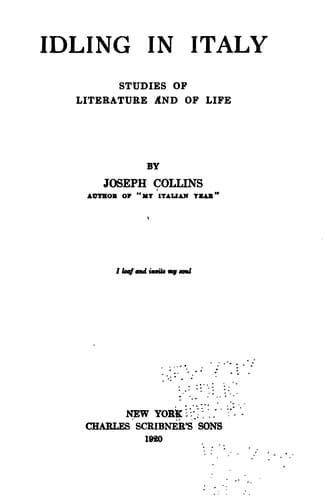
Idling in Italy: Studies of literature and of lifeCollins, Joseph
History
Idling in Italy: Studies of literature and of life
Collins, Joseph
Italian literature -- History and criticism
In the closing years of the century there was published in Milan a
volume of lyrics by one Annie Vivanti, which was praised intemperately
by Carducci and by the _Nuova Antologia_. She had some fiction to her
credit which dealt chiefly with the life of the stage, but her advent
into the world of letters was like a shooting star; nothing was known of
her origin save that she was said to have been born in London, and there
was some mystery about her career. In her poetry there was a true lyric
wail, especially in "Destino" ("Destiny"), "Non Sarà mai" ("It Can Never
Be"), that appealed tremendously to the public mind. Had she been
productive she might have been compared to Ella Wheeler Wilcox. After
her marriage to Mr. Chartres, a London journalist, she became better
known as the mother of a child-wonder violinist. Amongst her romances
the one which had greatest popularity was entitled "I Divoratori" ("The
Devourers"). It is obviously the story of her life and of her daughter's
career, the record of filial shortcomings steeped in wormwood.
The third of these interesting writers, half Armenian, half Italian, was
Vittoria Aganoor, who was born in Padua in 1855. In 1900 she published a
volume called "Leggenda Eterna" ("Eternal Legend"), which showed her to
be a sincere, impassioned artist with a pronounced leaning toward the
sentimental. She died in London in the spring of 1910, after a surgical
operation, and a few hours later her husband, Guido Pompili, killed
himself. Her best-known poems are "Il Canto dell' Ironia" ("The Song of
Irony"), "La vecchia Anima sogna ... " ("The Old Soul Dreams"), "Mamà,
sei tu?" ("Mother, Is It Thou?"). A complete volume of her poetry was
published in 1912.
Italians are astonished when women make a great stir in the world. They
have had no Jeanne d'Arc or Florence Nightingale. Their historic women
have been mostly mystics who would punish the flesh that they might
become spiritually pure, but the generation that is now passing has had
five women, four at least of whom will have to be discussed by any
historian of the intellectual movement in the latter half of the
nineteenth century. They are Matilde Serao, Grazia Deledda, Maria
Montessori, Eusapia Palladino, and Eleanora Duse, and most space will be
given to Duse.
Public-domain text, read in full here on John Shaqi.
Reviews
Reviews
No reviews yet
Be the first to share your thoughts on this work.
Join the Discussion
Join the discussion
Sign in to leave a comment or review.
Sign InorCreate an account