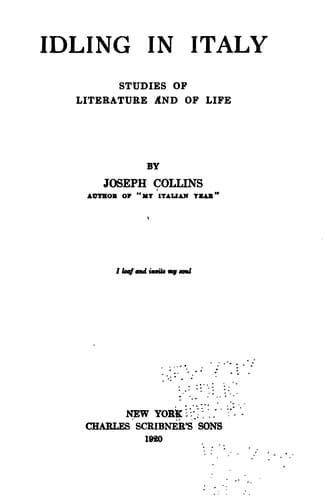
Idling in Italy: Studies of literature and of life — John Shaqi
Idling in Italy: Studies of literature and of lifeCollins, Joseph
History
Idling in Italy: Studies of literature and of life
Collins, Joseph
Italian literature -- History and criticism
Salvatore di Giacomo must be put at the head of all dialectical poets of
Italy. He is very little known to English readers, because he has been
so little translated, save into German. He is the librarian of the
National Library of the Naples Museum. The subjects of his poems are
drawn from Naples and its people, its beauty and their ardency; the
realism of his verse is sober, its sentiments are healthy and true to
human nature but to the human nature of a voluptuous, passionate people.
He writes of love in all its aspects, and of death, physical, emotional,
and mental. He knows the hopes, aspirations, sympathies, longings,
customs of his fellow Neapolitans; he knows them when they are ill, when
they are happy, and when they are depressed, when they are fortunate and
when they are seeped in misfortune, and he puts them into lyrics that
they understand and that poetasters praise.
His lyrics have been collected into one volume called "Poesie." He has
been called the Robert Burns of Italy, and it is likely that he deserves
it. It is to be regretted that no one has attempted to render him in
English.
An Italian poet neglected and almost unknown during his lifetime
(1872-1919), whose literary output was very small, is slowly coming to
his estate and it is not unlikely that the coming generation will hail
Ceccardo Roccatagliata-Ceccardi as one of Italy's greatest modern poets.
"Sonetti e Poemi" contains practically all of his verse save a small
collection published when he was twenty.
CHAPTER III
GABRIELE D'ANNUNZIO--POET, PILOT, AND PIRATE
The most conspicuous name in the annals of Italian literature of the
generation now passing is that assumed by a child or a youth when the
voice first whispered to him that he had been chosen to announce the
coming of a new era, to blaze the way for a new social and national
life: Gabriele D'Annunzio. He was born at Pescara in the Regno, March
13, 1863, the son of Francescopaolo D'Annunzio and of his wife, Luisa de
Benedictis of Ortona. A studied effort has been made to envelop his
birth and parentage in a mantle of mystery, but it has been thwarted.
One day of his infancy, in Ferravilla-on-the-Sea, suddenly there came a
sound from heaven as of a rushing mighty wind. From that moment the
little Annunciator was filled with the gift of verbal expression. He
enhanced the endowment by diligent study in the high school at Prato, in
Tuscany, where he spent his boyhood. Thus did he acquire an unparalleled
mastery of the Italian language. The gods of mythology, the Hellenic
heroes and philosophers, the emperors and courtesans of Pagan Rome were
the loves of his infancy. After Carducci's "Odi Barbari" exploded his
poetic magazine he looked about to find a god and a Greek upon whom to
model his conduct. He recalled Dionysus going through the world with
Priapus ostentatiously displaying the Phallus, and the die was cast.
Public-domain text, read in full here on John Shaqi.
Reviews
Reviews
No reviews yet
Be the first to share your thoughts on this work.
Join the Discussion
Join the discussion
Sign in to leave a comment or review.
Sign InorCreate an account