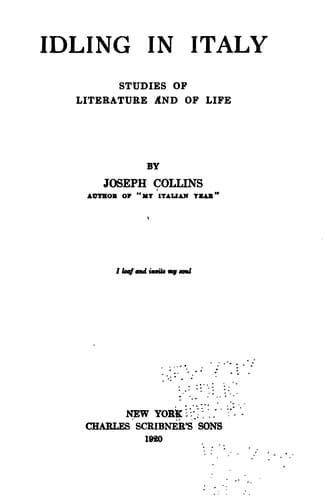
Idling in Italy: Studies of literature and of lifeCollins, Joseph
History
Idling in Italy: Studies of literature and of life
Collins, Joseph
Italian literature -- History and criticism
Several of Grazia Deledda's novels have been translated into English,
but they have not had great success. She is one of the last of the
realistic idealizers. The most her admirers can hope that the future
will do for her is that it will suggest to those in search of Sardinian
color that they should consult her writings. Neither the psychologist
nor the literary craftsman will disturb her literary remains.
The most promising successor of these women novelists is Clarice
Tartufari, whose "Rete d'Acciaio" ("Nets of Steel") is a powerful though
painful study of the Sicilian brand of jealousy.
Arturo Graf (1848-1918), for many years a professor in the University of
Turin, was a materialistic poet whose productions during his lifetime
were received with some favor and are now being given high rating.
Fifteen years ago a very flattering review of his dramatic poems,
especially "Medusa," appeared in the _Nuova Antologia_, and recently
Signor Vittorio Gian has published in _Gazetta di Torino_ an analysis of
his mental processes and an estimate of the merit and significance of
his poetical productions which, should they find general acceptance, may
give Graf the most important position in the poetic field since Pascoli.
Neither his intellectual reactions nor his point of view, however, is
Italian. They show both his Teutonic origin and inclinations. His last
verses, "Nuove Rime della Selva" ("New Rhymes of the Forest"), are full
of delightful imagery, delicate fantasy, and gentle sentiment and they
do not display the materialism, pessimism, or the figurative symbolism
of his early works. In 1900 he published a psychological romance
entitled "Riscatto" ("Redemption"), admittedly a spiritual autobiography
which heralded and prepared his after-faith, which was thus also a
battle for a faith against materialistic pessimism, against arid
positivism which had seduced him and against which he reacted. "He who
seeks God laboriously may become more religious than he who coddles Him
in the firm belief of having found Him." His book of poems published in
1895 is the poet's voicings of his struggle to this end. His fame is
greater as a dramatist and litterateur than as a poet. Nevertheless some
of his poetical writings show a rare imagery, a facile capacity for
description and versification, though a pessimistic psychology. His
best-known poems are entitled "Venezie" ("Venices"), "Le Rose sono
sfiorite" ("Faded Roses"), "Silenzio" ("Silence"), "Anelito"
("Longings"). Gian says of him: "He did not attain in his career as
teacher, writer, and poet that outward recognition that fame and fortune
usually bestow on their favorites," but as a recompense "he was honored
with such hatreds as are never the lot of mediocrities and which for
this very reason are the sanction and almost the guaranty of true
worth."
Much of the interesting literature of the past generation has appeared
in dialect, especially the poetic literature.
Public-domain text, read in full here on John Shaqi.
Reviews
Reviews
No reviews yet
Be the first to share your thoughts on this work.
Join the Discussion
Join the discussion
Sign in to leave a comment or review.
Sign InorCreate an account