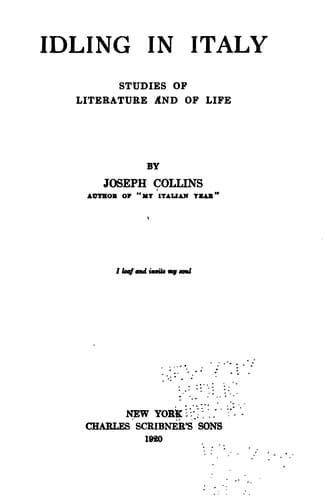
Idling in Italy: Studies of literature and of life — John Shaqi
Idling in Italy: Studies of literature and of lifeCollins, Joseph
History
Idling in Italy: Studies of literature and of life
Collins, Joseph
Italian literature -- History and criticism
his seduction of his own wife, who in the new covenant is his sister.
Meanwhile with consummate art he has described in the first chapter as
the only true love that which exists between brother and sister, his
apostrophe of it having been called forth by recalling the sister whom
death had fortunately removed.
Before he has accomplished the seduction of his wife-sister he has
precipitated her into a vulgar adventure with his own brother, a pattern
of all the virtues. It is a part of his consummate art to create
circumstantial evidence that will tend to put the paternity of her child
upon a fellow author who in other days had been civil and courteous to
his wife, and had sent her a copy of his latest book with an enigmatical
inscription on the fly-leaf, but in reality he succeeds in creating an
atmosphere from which one senses with readiness that the real father is
his brother. The book, in so far as it is concerned with the nobility of
Giuliana, the sweetness of life in the country, the lovability of her
mother and her children, the way in which Giuliana's emotions and
thought after the advent of the child are shaped that she may grow to
hate it as he hates it, as well as the mental elaborations that justify
him in seeking to destroy it, and the accomplishment of it, are done in
a way that shows the author to be not only intimately familiar with the
workings of the normal human mind but with the depraved human mind.
From the beginning of his literary career D'Annunzio was at no pains to
conceal that he was the model from which he painted his heroes. The
reader who identifies him with Tullio Hermil is the perspicacious
reader, in the eyes of the author; the reader who considers the conduct
of Tullio, infracting as it does the canons of law, of morality, and of
decency, as the conduct of a superman, is, in the judgment of the
author, the sapient reader. He who sees in Tullio and his conduct a
beast abnormally freighted with lubricity, lacking in inhibitory
qualities of a man unguided and uninfluenced by any obligation to God or
man, and knowing no other obligation than the pursuit of his own
pleasures and desires, is a fool, a weakling, an inanimate mass of
protoplasm moulded in the form of a human being unworthy of
consideration. D'Annunzio conceived himself a superman long before he
began to write romances, and I am not one of those who believe that he
got his conception from Nietzsche. He got it from the same indescribable
source that that unbalanced monster of materialism got his. Its roots if
they could be traced back to the days of the Hebrew prophets would be
found to have their germinal sprouts in some descendant of Samuel or
David.
Public-domain text, read in full here on John Shaqi.
Reviews
Reviews
No reviews yet
Be the first to share your thoughts on this work.
Join the Discussion
Join the discussion
Sign in to leave a comment or review.
Sign InorCreate an account