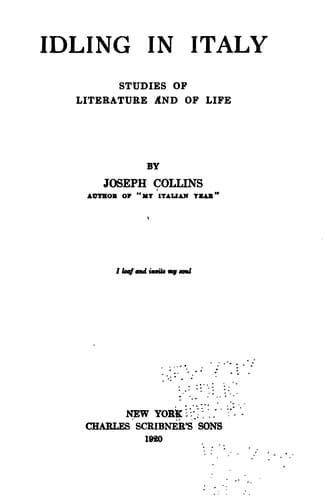
Idling in Italy: Studies of literature and of lifeCollins, Joseph
History
Idling in Italy: Studies of literature and of life
Collins, Joseph
Italian literature -- History and criticism
D'Annunzio's romances are a mixture of materialism, sensualism, and
pessimism reduced in a pagan mortar to a homogeneous consistency, and
then skilfully admixed with honey so that it is acceptable to the
Christian palate, but, once it has got beyond the taste-buds of the
tongue, once it is taken into the system, its poisonous, corroding, and
destructive qualities become operative. I doubt if D'Annunzio ever wrote
a word or line in his plays or romances that any one was the better for
having read or heard, and by better I mean that he added to his
spiritual possessions, to his inherent nobility, or to his aspirations
for a moral perfection, one iota. I doubt if any normal human being,
normal physically, mentally, and spiritually, can read "Il Piacere"
without feeling ill and humiliated, not because of the picture that the
author draws of himself in the guise of Andrea Sperelli, this finished
expert in the employments of love, nor of Donna Maria, nor of the woman
more infernally expert in those matters, nor the score of other
characters which he paints with a master-hand, but because of the way in
which he draws his bow across the overtaut strings of sensuousness until
they scream and wail in frenzied fashion and then finally burst asunder.
The way in which he makes an appeal to his perverted sensuality through
vicarious overstimulation of the senses with which he was endowed for
self-conservation and self-preservation, the senses of smell and sight
and touch and hearing, is in itself a perversion. He stimulates them
until they shriek for mercy or for immersion in some benumbing balm. The
true pervert is he who puts out of proportion and out of perspective the
sources of æsthetic emanation, and who concentrates them upon the
percipient apparatus of one or other of the senses so that it may be
excited to a frenzied activity. The description of Andrea's room, in
which he awaits Donna Maria, with its perfumes, lights, and colors, and
the description of his toilet articles and his bedroom is one of the
most nauseating things in all literature. Like Nietzsche, D'Annunzio
looks upon women as creatures of an inferior race, instruments of
pleasure and procreation who were created to serve. When they no longer
are amusing, useful, or serviceable they are to be brushed aside and
with the same _sang froid_ as one would put aside an automobile that had
broken down, worn out, or because it's "corpo non è più giovane," as he
kept saying of Foscarina in "Il Fuoco," who belonged to him, "like the
thing one holds in his fist, like the ring on one's finger, like a
glove, like a garment, like a word that may be spoken or not, like a
draft that may be drunk or poured on the ground."
Public-domain text, read in full here on John Shaqi.
Reviews
Reviews
No reviews yet
Be the first to share your thoughts on this work.
Join the Discussion
Join the discussion
Sign in to leave a comment or review.
Sign InorCreate an account