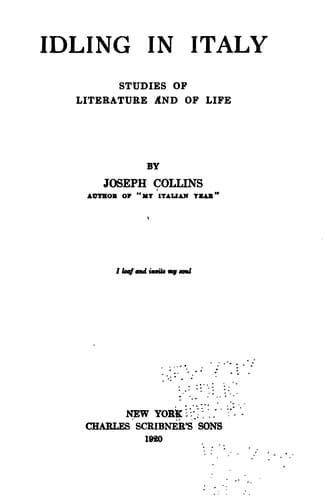
Idling in Italy: Studies of literature and of lifeCollins, Joseph
History
Idling in Italy: Studies of literature and of life
Collins, Joseph
Italian literature -- History and criticism
In "Vergini delle Rocce" he expounds the theory that inequality is the
essence of the state, and in this book as well as in "Il Trionfo della
Morte" we find all the passion of language and of sentiment that one
finds in Nietzsche. It is no longer to be doubted that he had kept his
word "noi tendiamo l'orecchio alla voce del magnanimo Zarathustra e
prepariamo nell' arte con sicura fede l'avvento del Uebermensch del
superuomo"--we listen to the voicing of the magnanimous Zarathustra and
we prepare with unfaltering faith for the coming of the superman to the
arts.
In his life of Cola di Rienzo D'Annunzio again took occasion to lampoon
and traduce the common people, describing them as the great beast which
must be crushed and annihilated. "Il Trionfo della Morte" is the very
essence of Heraclitan philosophy and Dionysan ethics. The hero, who is a
paragon of knowledge which he displays for the reader's edification,
meets the young and pretty wife of a business man who bores her. He is
successful finally in permitting her to pass a few weeks with him in his
villa by the sea. During these weeks they run the gamut of every
conceivable sensation and the reader gets a description of them and of
the gradual hatred that develops in him for his subjection of her.
"Every human soul carries in it for love a definite quality of sensitive
force. This quality is used up with time and when it is used up no
effort can prevent love from ceasing." But, unlike the animal when his
concupiscence is satiated and he is still urged to greater display, the
hero is not content with driving her from him; he must needs mete out
the same fate to her that he did to the infant in "Il Piacere," so he
lures her to the edge of a sea cliff and hurls her into space. "She
would in death become for me matter of thought, pure ideality; from a
precarious and imperfect existence she would enter into an existence
complete and definite, forsaking forever the infirmities of her weak,
luxurious flesh. Destroy to possess. There is no other way for him who
seeks the absolute in love."
The reader yields to the enchantment of his style, to the seductiveness
of his lyrism, to the intoxications of his descriptions of beauty; and
the critic and fellow writer to his mastery of technic and consummate
mastery of behavioristic psychology. From the critics' point of view
"The Triumph of Death" and "The Fire" are the high-water marks of
D'Annunzio as a stylist, and they mark his completest moral dissolution.
Public-domain text, read in full here on John Shaqi.
Reviews
Reviews
No reviews yet
Be the first to share your thoughts on this work.
Join the Discussion
Join the discussion
Sign in to leave a comment or review.
Sign InorCreate an account