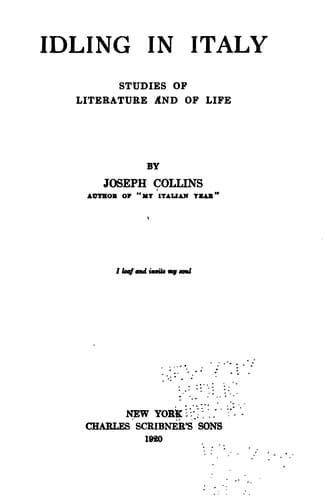
Idling in Italy: Studies of literature and of life — John Shaqi
Idling in Italy: Studies of literature and of lifeCollins, Joseph
History
Idling in Italy: Studies of literature and of life
Collins, Joseph
Italian literature -- History and criticism
It was a strange awakement that D'Annunzio had when he went to Rome in
the early '90's. Perhaps it was before that time that he encountered
"L'Ornement des Noces Spirituelles de Ruysbroeck l'Admirable," and later
"La Sagesse et la Destinée," and he absorbed some of its æsthetic
mysticism. He realized that it was another variety of search for wisdom
because it is happiness, and he began to portray it in his poetry and
tragedies. From the day he began to write he accustomed himself to take
as it pleased him from others' writings, and not only lines and
paragraphs but subjects, movements, cadences, thoughts, and images which
determined the character and decided the nature of the production.
Italian critics have taken the trouble to return to the original
creators the borrowed constituents of some of his productions,
"L'Asiatico," for instance; and that which then remained was the
caressing modulation of the verses. When his romances appeared in French
many of the passages taken bodily from Dostoievsky, Tolstoy, de
Maupassant, Pêladan, de Goncourt, Huysmans, and many others were
prudently suppressed. But no one can fail to recognize that he read
these authors with a keen eye, a note-book by his side. But he has known
how to use what he borrowed. The day came when the conduct of a corrupt
people in a decadent fictitious world no longer sufficed to divert him;
having drunk from the poisoned springs of lust not only to satiety but
to disgust, he, like his prototype of Huysmans's creation, "Des
Esseintes," the Thebaide raffinée of "A Rebours," must hide himself away
far from the world, in some retreat where he might deaden the discordant
sounds of the rumblings of inflexible life, as one deadens the street
with straw where an important or beloved one is sick. This retreat was
Paris and there we must leave him making scenic plays and erudite verse
for a Russian ballerina, and working out his destiny in contemplation of
death and in planning the selection of warriors for Valhalla.
We are not concerned with his conduct or with his morals. We are
concerned with his activities to divert and instruct us, and the
influence that his efforts had upon the people of his time. He wrote
artistically perfect novels; his poetry is the highest form of lyric
expression; he made his dramas the revivification of the elements of
Greek tragedy; and he strove to prove that Eros was unconquerable by
priest, sage, or warrior. Now, with the world in ferment, they are the
only earnest for our acceptation of his assurance that he can shape the
fate of Italy more acceptably than its statesmen.
Before the Great War he had practically passed from the stage of
letters. That epochal occurrence resurrected him. We can wait to hear
what posterity will say of him.
CHAPTER IV
THE FUTURIST SCHOOL OF ITALIAN WRITERS
Public-domain text, read in full here on John Shaqi.
Reviews
Reviews
No reviews yet
Be the first to share your thoughts on this work.
Join the Discussion
Join the discussion
Sign in to leave a comment or review.
Sign InorCreate an account