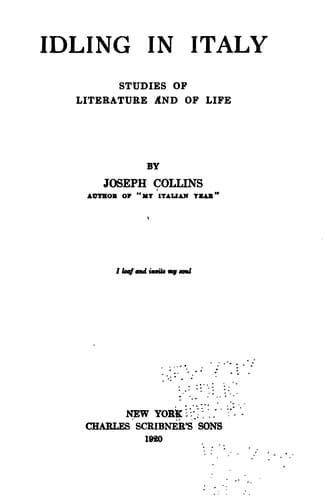
Idling in Italy: Studies of literature and of lifeCollins, Joseph
History
Idling in Italy: Studies of literature and of life
Collins, Joseph
Italian literature -- History and criticism
They claim instead that the best of life is to be found in purposeful
action; that life should be speeded up, and that every one should be
encouraged to live fully for the advantage that may come to himself, to
those to whom he is beholden, and to the world. They advocate the
strenuous life and invite the new and unforeseen, while urging
exploration of untrodden fields and especially determination of things
called inaccessible and unrealizable. They advocate equal life for men
and women, and seek to give to such words as "patriotism" and "idealism"
a fuller significance, so that the former shall not mean the heroic
idealization of commercial, industrial, and artistic solidarity of a
people but a love of liberty and a knowledge, recognition, and
appreciation of what other people and other countries are attempting and
accomplishing; and that the latter may be applied to the affairs of life
and not to the affairs of the imagination.
This movement, in Italy, was begun by a group of men who called
themselves Futurists and, if that name can be dissociated from the
connotation that is given to it when applied to art, I see no objection
to it. It has been influenced by the French Symbolists of the preceding
generation, Baudelaire, de Goncourt, Villiers de l'Isle-Adam, Mallarmé,
Verlaine, Huysmans, Rimbaud, whose work so profoundly influenced the
course of French literature. Like this school the self-styled futuristic
writers of Italy revolt against rhetoric and against tradition.
Therefore they reject equally the ardent classicism of Carducci and
D'Annunzio's decadent blend of idealism and realism, the crass, slavish
Gallicism of Brocchi, the Scandinavian genuflections of Bracco and the
Shavian imitations of Pirandello. In protest against all these they seek
the full liberty of the written word, as the evangel of socialism seeks
the liberty of the individual. Not from other writers but from reality
itself, or from the depths of their own imaginations, they have received
a vision and this vision they demand the right to evoke in others, by
what words or what images they will. The art of expression should be
speeded up, abbreviated, and epitomized, while the love of profound
essentials is cultivated. To borrow from England's singer of
materialistic grandeur and promise, they
" ... want the world much more the world;
Men to men and women to women--all
Adventure, courage, instinct, passion, power."
And in addition, as true Futurists, they want us to have constantly in
mind what happened to Lot's wife when she looked back to see how high
the flames rose over Sodom and Gomorrah.
The leaders of the Futuristic movement in Italy were Guillaume
Apollinaire, then editor of _Les Soirées de Paris_, and F. T. Marinetti
of Milan.
Public-domain text, read in full here on John Shaqi.
Reviews
Reviews
No reviews yet
Be the first to share your thoughts on this work.
Join the Discussion
Join the discussion
Sign in to leave a comment or review.
Sign InorCreate an account