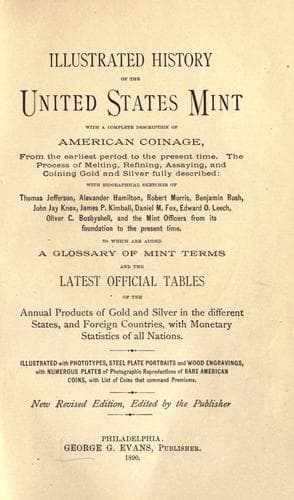
Illustrated history of the United States mint: with a complete description of American coinage, from the earliest period to the present time
History
Illustrated history of the United States mint: with a complete description of American coinage, from the earliest period to the present time
Coinage -- United States; Mints -- United States
On the left is the Deposit or Weighing-room, where all the gold and
silver for coining is received and first weighed. The largest weight used
in this room is five hundred ounces, the smallest, is the thousandth
part of an ounce. The scales are wonderfully delicate, and are examined
and adjusted on alternate days. On the right of this room is one of the
twelve vaults in the building. Of solid masonry, several of them are
iron-lined, with double doors of the same metal and most complicated and
burglar-proof locks.
[Illustration: AUTOMATIC WEIGHING SCALES.]
It is estimated that about fifteen hundred million dollars worth of
gold has been received and weighed in this room; probably nine-tenths
of this amount was from California, since its discovery there in the
year 1848. Previous to that time the supplies of gold came principally
from Virginia, North Carolina, and Georgia. During the past ten years
considerable quantities have been received from Nova Scotia, but most
of the gold that reaches the Mint, at the present time, comes from
California, Montana, Colorado, Idaho, Nevada, Arizona, Oregon, Dakota,
Virginia, South Carolina, and New Mexico.
Formerly the silver used by the Mint came principally from Mexico and
South America, but since the discovery of the immense veins of that metal
in the territories of the United States the supply is furnished from the
great West.
The copper used comes principally from the mines of Lake Superior, the
finest from Minnesota. The nickel is chiefly from Lancaster County, Pa.
THE DEPOSIT MELTING ROOM.
After the metal has been carefully weighed in the presence of the
depositor and the proper officials, it is locked in iron boxes and taken
to the melting room, where it is opened by two men, each provided with
a key to one of the separate locks. There are four furnaces in this
room, and the first process of melting takes place here. The gold and
silver, being mixed with borax and other fluxing material, is placed in
pots, melted and placed in iron moulds, and when cooled is again taken
to the deposit room in bars, where it is reweighed, and a small piece
cut from each lot by the Assayer. From this the fineness of the whole is
ascertained, the value calculated, and the depositor paid. The metal in
its rough state is then transferred to the Melter and Refiner.
OFFICE OF THE MELTER AND REFINER.
Adjoining the Deposit Melting Room are the Melter and Refiner and
assistants. This is the general business office of the head of this
department, and is also used for weighing the necessary quantities of the
metals used in alloying coin.
THE PROCESS OF ASSAY.
Public-domain text, read in full here on John Shaqi.
Reviews
Reviews
No reviews yet
Be the first to share your thoughts on this work.
Join the Discussion
Join the discussion
Sign in to leave a comment or review.
Sign InorCreate an account