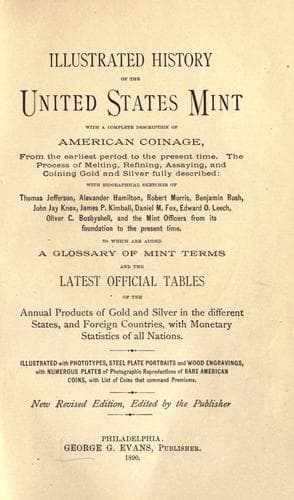
Illustrated history of the United States mint: with a complete description of American coinage, from the earliest period to the present time
History
Illustrated history of the United States mint: with a complete description of American coinage, from the earliest period to the present time
Coinage -- United States; Mints -- United States
The two essential things regarding every piece of metal offered in
payment of any dues were, first, the weight or quantity, next, the
fineness or purity of the same. The process of weighing even the baser
metals used in coining must be conducted by the careful use of accurate
scales, with precise notes of the results. In precious metals, gold,
silver, and their high grade alloys, a very small variation in the
fineness makes a great difference in the value. Nothing is more essential
than the accurate determination of the weight of the sample and of
the metal obtained from it. It requires keen sight and most delicate
adjustment in the hand which manipulates the Lilliputian scales of
an Assayer’s table. The smallest weight used in the Mint is found in
the Assay Room; it is the thirteen-hundredth part of a grain, and can
scarcely be seen with the naked eye, unless on a white ground. The Assay
Department is strictly a technical and scientific branch of the service.
It has been practically under one regime, for the last fifty years. There
have been but three Chief Assayers in that time, the only removals being
by death, the only appointments by promotion. Its workmen are all picked
men, selected from other parts of the Mint for special fitness and good
character.
THE ASSAYING ROOMS.
These are on the second floor, in the southwest corner of the building.
In one of these are fires, stills, and other appliances used in the
delicate and complicated process of assay, by which the specific standard
of the fineness and purity of the various metals are established and
declared.
ASSAYING GOLD.
The gold is melted down and stirred, by which a complete mixture is
effected, so that an assay piece may be taken from any part of the bar
after it is cast. The piece taken for this purpose is rolled out for the
convenience of cutting. It is then taken to an assay balance (sensible
to the ten-thousandth of a half gramme or less), and from it is weighed
a half gramme, which is the normal assay weight for gold, being about
7.7 grains troy. This weight is stamped 1000; and all the lesser weights
(afterwards brought into requisition) are decimal divisions of this
weight, down to one ten-thousandth part.
Public-domain text, read in full here on John Shaqi.
Reviews
Reviews
No reviews yet
Be the first to share your thoughts on this work.
Join the Discussion
Join the discussion
Sign in to leave a comment or review.
Sign InorCreate an account