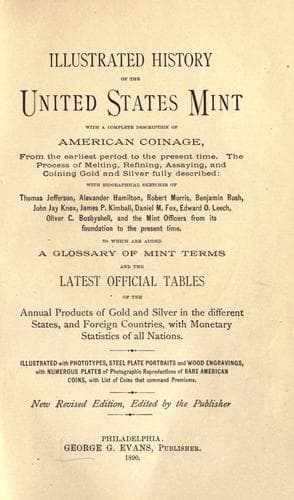
Illustrated history of the United States mint: with a complete description of American coinage, from the earliest period to the present time — John Shaqi
Illustrated history of the United States mint: with a complete description of American coinage, from the earliest period to the present time
History
Illustrated history of the United States mint: with a complete description of American coinage, from the earliest period to the present time
Coinage -- United States; Mints -- United States
The composition of the five and three cent pieces is one-fourth nickel;
the balance copper. The bronze pieces were changed in 1859, and are a
mixture of copper, zinc and tin, about equal parts of each of the two
last; the former contributing about 95 per cent. There are seven furnaces
in this room, each capable of melting five hundred pounds of metal per
day. When the metal is heated and sufficiently mixed, it is poured into
iron moulds, and when cool, and the rough ends clipped off, is ready to
be conveyed to the rolling room.
THE ROLLING ROOM.
From the melting rooms through the corridor we reach the rolling room.
The upright engine, on the right, of one hundred and sixty horse power,
supplies the motive force to the rolling machines, four in number. Those
on the left, are massive and substantial in their frame-work, with
rollers of steel, polished by service in reducing the ingots to planchets
for coining. The first process or rolling is termed breaking down; after
that it requires to be passed through the machine until it is reduced to
the required thinness—ten times if gold, eight if silver, being annealed
in the intervals to prevent breaking. The rollers are adjustable and the
space between them can be increased or diminished at pleasure, by the
operator. About two hundred ingots are run through per hour on each pair
of rollers.
The pressure applied is so intense that half a day’s rolling heats, not
only the strips and rollers, but even the huge iron stanchions, weighing
several tons, so hot that you can hardly hold your hand on them.
When the rolling is completed the strip is about six feet long, or six
times as long as the ingot.
It is impossible to roll perfectly true. At times there will be a lump of
hard gold, which will not be quite so much compressed as the rest. If the
planchets were cut from this place, it would be heavier and more valuable
than one cut from a thinner portion of the strip. It is, therefore,
necessary to “draw” the strips, after being softened by annealing.
[Illustration: ROLLING MACHINE.]
ANNEALING FURNACES.
These are in the same room, to the right facing the rollers. The gold
and strips are placed in copper canisters, and then placed in the
furnaces and heated to a red heat; silver strips being laid loosely in
the furnace. When they become soft and pliable, they are taken out and
allowed to cool slowly.
THE DRAWING BENCHES.
Public-domain text, read in full here on John Shaqi.
Reviews
Reviews
No reviews yet
Be the first to share your thoughts on this work.
Join the Discussion
Join the discussion
Sign in to leave a comment or review.
Sign InorCreate an account