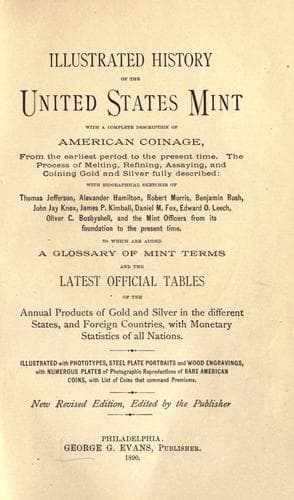
Illustrated history of the United States mint: with a complete description of American coinage, from the earliest period to the present time
History
Illustrated history of the United States mint: with a complete description of American coinage, from the earliest period to the present time
Coinage -- United States; Mints -- United States
The silver in the condition in which it is received from the hands of
the depositor, and generally filled with foreign impurities, is melted
and then granulated, after which the whole mass is dissolved with nitric
acid. The acid dissolves the base metals as well as the silver. The
liquid metals are then run into tubs prepared for it, and precipitated,
or rendered into a partially hard state, by being mixed with common
salt water. After being precipitated it is called “chloride,” and
resembles very closely new slacked lime. By putting spelter or zinc on
the precipitated chloride, it becomes metallic silver, and only needs
washing and melting to make the purest virgin metal. The base metals
remain in a liquid state, and being of little value are generally thrown
away. The process of refining silver is of two kinds; that of melting it
with saltpetre, etc., which was known some thousands of years since, and
the modern process of dissolving it in nitric acid, like the method of
extracting it from gold in the above described operation.
After the separating process has been completed, the gold or silver is
conveyed to the Drying Cellar, where it is put under pressure of some
eighty tons, and all the water pressed out. It is then dried with heat,
and afterwards conveyed in large cakes to the furnaces.
THE MELTING ROOMS
are on the first floor, in the west side of the building. Here all the
metal used in coining is alloyed, melted and poured into narrow moulds.
These castings are called ingots; they are about twelve inches long,
a half-inch thick, and vary from one to two a half-inches in breadth,
according to the coin for which they are used, one end being wedge-shaped
to allow its being passed through the rollers. The value of gold ingots
is from $600 to $1,400; those of silver, about $60. The fine gold and
silver bars used in the arts and for commercial purposes, are also cast
in this department.
[Illustration: CASTING INGOTS.]
[Illustration: INGOTS.]
These are stamped with their weight and value in the deposit room. The
floors that cover the melting rooms are made of iron in honey-comb
pattern, divided into small sections, so that they can be readily taken
up to save the dust; their roughness acting as a scraper, preventing any
metallic particles from clinging to the soles of the shoes of those who
pass through the department, the sweepings of which, and including the
entire building, averages $23,000 per annum, for the last five years.
The copper and nickel melting rooms, wherein all the base metals used
are melted and mixed, is on the same side and adjoining to the gold and
silver department. Up to the year 1856, the base coin of the United
States was exclusively copper. In this year the coinage of what was
called the nickel cents was commenced. These pieces, although called
nickel, were composed of one-eighth nickel; the balance was copper.
Public-domain text, read in full here on John Shaqi.
Reviews
Reviews
No reviews yet
Be the first to share your thoughts on this work.
Join the Discussion
Join the discussion
Sign in to leave a comment or review.
Sign InorCreate an account