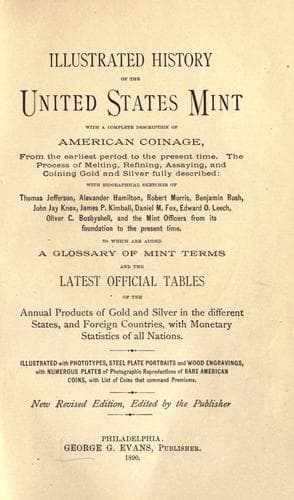
Illustrated history of the United States mint: with a complete description of American coinage, from the earliest period to the present time
History
Illustrated history of the United States mint: with a complete description of American coinage, from the earliest period to the present time
Coinage -- United States; Mints -- United States
The upper shaft, on which are seen the three large wheels, has also
fastened to it, over each press, an eccentric wheel. In the first
illustration will be seen three upright rods running from near the table
to the top. The middle one is connected with a tire around the eccentric
wheel, and rises and falls with each revolution. The eccentric power
gives great rapidity of motion with but little jerking.
The operator places one end of a strip of metal in the immense jaws of
the press, and cuts out a couple of planchets, which are a fraction
larger than the coin to be struck. As the strips are of uniform
thickness, if these two are of the right weight, all cut from that strip
will be the same. They are therefore weighed accurately. If right, or a
little heavy, they are allowed to pass, as the extra weight can be filed
off. If too light, the whole strip has to be re-melted. As fast as cut
the planchets fall into a box below, and the perforated strips are folded
into convenient lengths to be re-melted. From a strip worth say eleven
hundred dollars, eight hundred dollars of planchets will be cut.
ADJUSTING ROOM.
[Illustration: DELICATE SCALES.]
The planchets are then removed to the adjusting room, where they are
adjusted. This work is performed by ladies. After inspection they are
weighed on very accurate scales. If a planchet is too heavy, but near
the weight, it is filed off at the edges; if too heavy for filing, it is
thrown aside with the light ones, to be re-melted. To adjust coin so
accurately requires great delicacy and skill, as a too free use of the
file would make it too light. Yet by long practice, so accustomed do the
operators become, that they work with apparent unconcern, scarce glancing
at either planchets or scales, and guided as it were by unerring touch.
The exceedingly delicate scales were made under the direction of Mr.
Peale, who greatly improved on the old ones in use. So precise and
sensitive are they that the slightest breath of air affects their
accuracy, rendering it necessary to exclude every draft from the room.
PROGRESS IN COINING.
The methods of coining money have varied with the progress in mechanic
arts, and are but indefinitely traced from the beginning; the primitive
mode, being by the casting of the piece in sand, the impression being
made with a hammer and punch. In the middle ages the metal was hammered
into sheets of the required thickness, cut with shears into shape, and
then stamped by hand with the design. The mill and screw, by which
greater increase in power, with finer finish was gained, dates back to
the Sixteenth Century. This process, with various modifications and
improvements, continued in use in the Philadelphia Mint until 1836.
[Illustration: ANCIENT COINING PRESS.]
Public-domain text, read in full here on John Shaqi.
Reviews
Reviews
No reviews yet
Be the first to share your thoughts on this work.
Join the Discussion
Join the discussion
Sign in to leave a comment or review.
Sign InorCreate an account