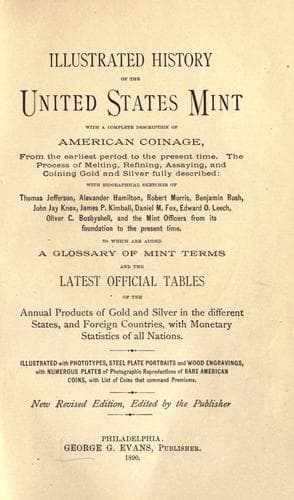
Illustrated history of the United States mint: with a complete description of American coinage, from the earliest period to the present time
History
Illustrated history of the United States mint: with a complete description of American coinage, from the earliest period to the present time
Coinage -- United States; Mints -- United States
The first steam coining press was invented by M. Thonnelier, of France,
in 1833, and was first used in the United States Mint in 1836. It was
remodeled and rebuilt in 1858, but in 1874 was superseded by the one now
in operation, the very perfection of mechanism, in which the vibration
and unsteady bearing of the former press were entirely obviated, and
precision attained by the solid stroke with a saving of over seventy-five
per cent. in the wearing and breaking of the dies.
[Illustration: STEAM COINING PRESS.]
DIES.
[Illustration: DIES.]
The dies for coining are prepared by engravers, especially employed
at the Mint for that purpose. The process of engraving them consists
in cutting the devices and legends in soft steel, those parts being
depressed which, in the coin, appear in relief. This, having been
finished and hardened, constitutes an “_original die_,” which, being
the result of a tedious and difficult task, is deemed too precious to
be directly employed in striking coins; but it is used for multiplying
dies. It is first used to impress another piece of soft steel, which
then presents the appearance of a coin, and is called a _hub_. This hub,
being hardened, is used to impress other pieces of steel in like manner
which, being like the original die, are hardened and used for striking
the coins. A pair of these will, on an average, perform two weeks’ work.
TRANSFER LATHE.
[Illustration]
The transfer lathe, a very complicated piece of machinery, is used in
making dies, for coins and medals. By it, from a large cast, the design
can be transferred and engraved in smaller size, in perfect proportion to
the original.
THE COINING AND MILLING ROOMS.
This department, the most interesting to the general visitor, occupies
the larger portion of the first floor on the east side of the building.
The rooms are divided by an iron railing, which separates the visitors,
on either side, from the machinery, etc., but allows everything to be
seen.
[Illustration: MILLING MACHINE.]
The planchets, after being adjusted, are received here, and, in order to
protect the surface of the coin, are passed through the milling-machine.
The planchets are fed to this machine through an upright tube, and, as
they descend from the lower aperture, they are caught upon the edge of
a revolving wheel and carried about a quarter of a revolution, during
which the edge is compressed and forced up—the space between the wheel
and the rim being a little less than the diameter of the planchet.
This apparatus moves so nimbly that five hundred and sixty half-dimes
can be milled in a minute; but, for large pieces, the average is about
one hundred and twenty. In this room are the milling machines, and the
massive, but delicate, coining presses, ten in number. Each of these is
capable of coining from eighty to one hundred pieces a minute. Only the
largest are used in making coins of large denominations.
[Illustration: PERFECTED COINING PRESS.]
[Illustration: COINING PRESS.]
Public-domain text, read in full here on John Shaqi.
Reviews
Reviews
No reviews yet
Be the first to share your thoughts on this work.
Join the Discussion
Join the discussion
Sign in to leave a comment or review.
Sign InorCreate an account