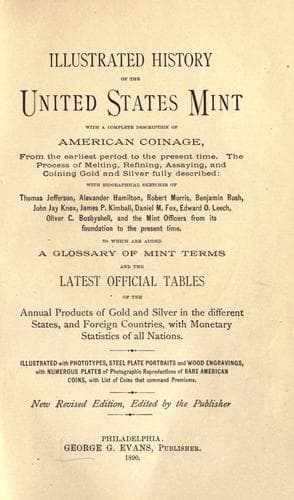
Illustrated history of the United States mint: with a complete description of American coinage, from the earliest period to the present time
History
Illustrated history of the United States mint: with a complete description of American coinage, from the earliest period to the present time
Coinage -- United States; Mints -- United States
A small case attracts no little attention, because it contains a single
coin; and the interest does not decrease when the inscription is read:
“Struck in the Philadelphia Mint, at least two thousand years ago.” The
late Assayer of the Philadelphia Mint, Mr. W. E. Du Bois, under title of
“The Temple Sweepers,” wrote, not long since, a valuable sketch of this
coin, made in the City of Attalus Philadelphus, Asia Minor, and for which
William Penn called his city, because the ancient one was a monument of
“brotherly love.” Diana was the patroness of Philadelphia.
“On one side, then, we have a head; not a king’s nor an emperor’s; as
yet the free city had a pride and a privilege above that. It is a female
head, an ideal, representing the city itself; or rather the dwellers
in it, the _Demos_. Here in this head and title, we have the radix of
Democracy.
“This is all we can gather from the obverse. On the other side we have a
larger variety: a running female figure; a dog also on the trot; a legend
of some length and of more significance.
“The half-clad figure is that of the goddess known to the Greeks as
Artemis, to the Latins as Diana; and otherwise called Selene, Phœbe,
Delia, or Cynthia.
“She was the favorite divinity of the cities of Asia Minor. Once the
patroness of chastity and purity. Goddess of the chase.”
The legend on the obverse of this coin explains its name: “Friends of
Philadelphia’s [her] Temple Sweepers.”
ORIENTAL.
Oriental coins are not as attractive as other varieties, though there
are special coins among them which have no rival in historic importance.
Antique coins from the East were usually without device, and, their
legends being rudely inscribed in a dead language, proved frequently to
be sealed fountains to the thirsting antiquarian. Therefore in cases
marked “Oriental” the visitor is undetermined where to begin to study,
and often decides to give it but little time.
Those having for device the sacred peacock are from Burmah; there
is, however, in the division marked “Selections” a very curious coin
belonging to that country, which certainly formed a part of its earliest
currency. It is a common gravel-stone, encased in a circling band of
brass.
COINS OF SIAM.
The coins of Siam are much sought for. Some of them, known to European
travelers as “bullet money,” are lumps of gold or silver, hammered by
rude implements into a doubtful roundness, and a few Siamese characters
stamped irregularly upon them. The sacred elephant is found on a large
proportion of their money. A Siamese coin in the Cabinet, of modern date,
is quite handsome in both workmanship and design. On the obverse is the
sacred elephant in ponderous proportion, which delights the eyes of the
devout, and the reverse presents a group of three pagodas, finely drawn.
In the case marked “Selections” is a Siamese coin of gold, comparatively
modern, called “Tecal,” corresponding in some respects to the “Shekel,”
or “Oxen,” of biblical fame.
CHINESE COINS.
Public-domain text, read in full here on John Shaqi.
Reviews
Reviews
No reviews yet
Be the first to share your thoughts on this work.
Join the Discussion
Join the discussion
Sign in to leave a comment or review.
Sign InorCreate an account