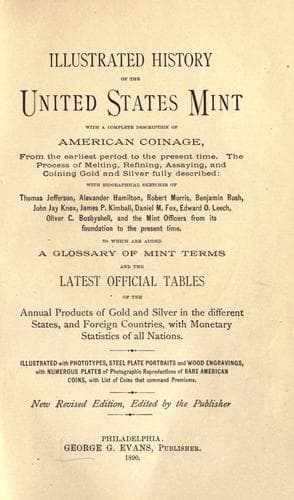
Illustrated history of the United States mint: with a complete description of American coinage, from the earliest period to the present time
History
Illustrated history of the United States mint: with a complete description of American coinage, from the earliest period to the present time
Coinage -- United States; Mints -- United States
No. 98, Junia; obverse, head of Liberty; reverse, Junius Brutus guarded
by lictors, and preceded by a herald, showing that an ancestor of
Junius Brutus was the first consul of Rome. Nos. 181, 182, Tituria.
The reverse shows two soldiers throwing their shields upon a prostrate
female, illustrating the famous story of the “Tarpeian Rock.” Reverse
represents the Romans carrying off Sabine women—a witness in coin of the
fact that the family of Tituria trace their ancestry from the Sabines.
To do justice to this case is impossible, for here are coins relating to
the ancestors of Antonia, Aurelia, Cornelia, Fulvia, Horatio, Lucretia,
Lucilla, Sempronia, Titia Valeria, and many others familiar to the
readers of history.
This era of coins terminated about the time of the birth of Christ, when
the
IMPERIAL COINS
were introduced. In noticing these, little save the labels on the case
can be given.
_Division II._
Julius Cæsar to Trajan, inclusive. Beginning 49 B.C., and ending 117 A.D.
A simple catalogue of the illustrious names on these coins would convey
an idea of their importance. All the victories of Cæsar are marked by
coinage; but out of the two hundred belonging to this case reference need
only be made to No. 24, a beautiful gold coin, with the undraped head
of Augustus, exquisitely severe, the interest attaching chiefly to the
legend, “The Son of God,” referring to the deification of Cæsar.
_Division III._
embraces from Hadrian to Elagabalus, 117-222. In the reign of Hadrian
much coin was issued, though it did not bear marks of the disasters and
revolts that signalized the foregoing. That he was a merciful ruler is
indicated by the coins, especially one—Hispania; the reverse showing the
emperor raising Spain—a female figure—from the ground. His travels are
also illustrated in coin.
_Division IV._
From Severus Alexander to Claudius Gothicus, 222-270. These coins
indicate the vicious effect of the rulers immediately preceding.
_Division V._
From Aurelian to the end of the Western Empire; includes 270-475. A
brilliant succession; Aurelian’s busy reign, ending in assassination; the
war-like Probus, the slave-emperor; Diocletian’s despotism and vindictive
persecution of Christians; the usurpation of Carausius; the happy reign
of Constantine the Great, Julian, Theodosius, down to Julius Nepos. These
are a few of the historic names and events presented in this division.
_Division VI._
covers the period of the Byzantine or Eastern Empire, and a lapse of
eight centuries; but the coinage is not comparable with that of other
eras, nor were events of so stirring and heroic a character. A general
decay, painful to contemplate, marked this long lapse of time, which
began near the acceptance of Christianity, and extended through the dark
ages.
“THE TEMPLE SWEEPERS.”
Public-domain text, read in full here on John Shaqi.
Reviews
Reviews
No reviews yet
Be the first to share your thoughts on this work.
Join the Discussion
Join the discussion
Sign in to leave a comment or review.
Sign InorCreate an account