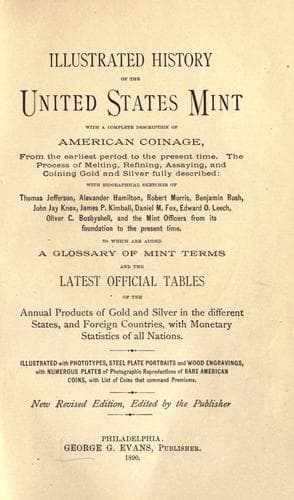
Illustrated history of the United States mint: with a complete description of American coinage, from the earliest period to the present time — John Shaqi
Illustrated history of the United States mint: with a complete description of American coinage, from the earliest period to the present time
History
Illustrated history of the United States mint: with a complete description of American coinage, from the earliest period to the present time
Coinage -- United States; Mints -- United States
Perhaps the peculiar adaptability of the Japanese character cannot be
better illustrated than by their late monetary revolution, especially as
their coinage is hedged around with laws, with penal attachments of no
doubtful character. In the small morocco case marked “Japan” are a few
specimens of their original coin. Of this series the large gold plate,
four inches by three and a half, is known as the “Gold Oban,” their
most valuable coin, worth about seventy-five dollars. This coin is of
perfectly smooth surface, with an elaborate black inscription of Japanese
text, burnt in by a chemical process. To take the “Gold Oban” out of the
kingdom is _punishable with death_; to remove it by mistake, subjects the
offender to imprisonment for life. The other coins in this case are, in
their composition and shape, as distinctive as the Japanese are peculiar
as a people. The progressive character of the Japanese is exemplified by
their recent acceptance of the United States system of coinage.
The mind of the Japanese proletaire has been much troubled in recent
years with regard to the coinage of his country; not that he ever has
much of the currency in question, but the Japanese proletaire has no
pockets, and he finds it awkward to carry in his hands such coins as he
contrives to possess. In ancient times his rulers were more considerate.
They punched square holes in the centre of the coins, through which he
passed a string, and was thus able to carry about his available capital
tied around his neck or to his waistband, which in those days was his
sole garment. The coins were not large in amount; it took a thousand of
them to make a few shillings, while a cart was required to convey five
dollars worth. But with civilization came an improved coinage, larger
in value, and with no holes, and the pocketless proletaire naturally
grumbled that civilization treated him hardly in this respect. Paper
currency for small amounts partially satisfied him for a time; but at
last his cries have been heard, and the Japanese Government has promised
to issue a new coin specially for his behoof. Its value is rather less
than one cent, and is to possess the indispensable hole, by which he can
string it as a child strings beads, and he is probably content.
TURKEY.
Turkish coins often bear texts from the Koran on either side, so it may
be said the tenets of their religion are their circulating medium. The
piastres in this collection are generally those now in circulation.
EGYPT.
Egypt’s antique coins were of Greek or Roman workmanship, of which the
very finest is in the case marked “Selections,” and has not its superior
for interest or beauty in the world. It was the work of some Greek
artist, and presents the head of Arsinoe, wife of Ptolemy. It was found
in 1868, and bought by the United States Government at a high price; but
as only three had been found, its market value may be named by thousands,
though its metal value is not more than twenty dollars.
Public-domain text, read in full here on John Shaqi.
Reviews
Reviews
No reviews yet
Be the first to share your thoughts on this work.
Join the Discussion
Join the discussion
Sign in to leave a comment or review.
Sign InorCreate an account