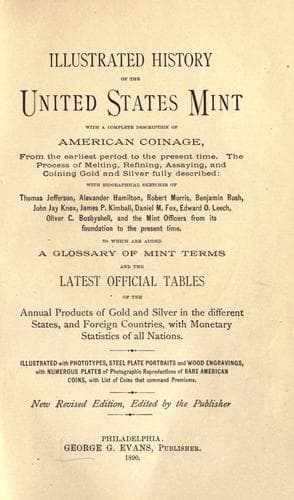
Illustrated history of the United States mint: with a complete description of American coinage, from the earliest period to the present time
History
Illustrated history of the United States mint: with a complete description of American coinage, from the earliest period to the present time
Coinage -- United States; Mints -- United States
This notice of Oriental coins may conclude with suggestive reference to
the “Cufic coins,” of which there are some valuable specimens. The first
is the silver dirhem of Walid, the eccentric caliph of Damascus, A.D.
713. There is also in case XV. a coin of the reign of Haroun Alraschid.
FRENCH COINAGE.
The French have the credit of making the greatest improvements in modern
coinage. The French coins are a history of that nation, from the small
coin issued in the reign of Louis “the Meek” to the last currency of the
republic of France, spanning a period of one thousand years.
In design and execution the French coins bear the impress of the national
character, and also give assurance of the art patronage in which her
rulers, failing in much, have never wavered, but brought all their power
and cunning to bear on securing the best artists, as in the instance
of Francis I. beguiling from the holy father that exquisite artist
Benvenuto Cellini, or the later _enterprise_ of Napoleon Bonaparte. No.
83,—a medalet of the unhappy Mario Antoinette,—which is in itself very
beautiful, and from its tragic association attracts general interest.
GERMANY.
The collection of Germany is very large and divided and sub-divided by
its kingdoms and principalities.
One of the most interesting coins of any age, and excelling in beauty as
well, is the gold medallic ducat on which are the heads of Martin Luther
and Philip Melanchthon. This coin is very generally admired by visitors
to the Cabinet.
COINS OF SWITZERLAND.
Switzerland is modestly represented in all her cantons, each, like the
classic Greek town, enjoying the coining privilege. There are several
pieces of commemorative and artistic worth, especially the two issues of
the republic of 1796.
RUSSIAN COINS.
The double rouble, with a magnificent draped head of Peter the Great, is
unexcelled for strength of outline, and valuable as a correct portrait of
one of the very greatest and most self-reliant of modern rulers. Turning
to another rouble, the features of Elizabeth II. are recognized. It may
be assumed, with all due deference to royalty, that this portrayal is the
most laughter-provoking figure ever stamped on metal. She is so fat as to
have the effect of “spreading herself” all over the coin. Another rouble
presents the majestic Catherine II.
Of the coins marked Denmark, Norway, Sweden, there can be only the
copper half-daler of Sweden mentioned. This coin is four inches square,
weighs about twelve ounces, and is equivalent to a United States silver
half-dollar. The daler of Sweden, thaler of Germany, dollar of Spain and
America, are all synonymous terms.
ENGLAND.
Public-domain text, read in full here on John Shaqi.
Reviews
Reviews
No reviews yet
Be the first to share your thoughts on this work.
Join the Discussion
Join the discussion
Sign in to leave a comment or review.
Sign InorCreate an account