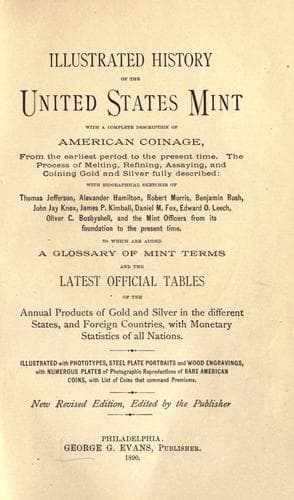
Illustrated history of the United States mint: with a complete description of American coinage, from the earliest period to the present time
History
Illustrated history of the United States mint: with a complete description of American coinage, from the earliest period to the present time
Coinage -- United States; Mints -- United States
The need of a circulating medium of exchange has been acknowledged
since the earliest ages of man. In the primeval days, bartering was the
foundation of commercial intercourse between the various races; but this
gave way in time, as exchanges increased. In the different ages many
commodities have been made to serve as money,—tin was used in ancient
Syracuse and Britain; iron, in Sparta; cattle, in Rome and Germany;
platinum, in Russia; lead, in Burmah; nails, in Scotland; silk, in China;
cubes of pressed tea, in Tartary; salt, in Abyssinia; slaves, amongst
the Anglo Saxons; tobacco, in the earliest settlements of Virginia;
codfish, in New Foundland; bullets and wampum, in Massachusetts;
logwood, in Campeachy; sugar, in the West Indies; and soap, in Mexico.
Money of leather and wood was in circulation in the early days of Rome;
and the natives of Siam, Bengal, and some parts of Africa used the
brilliantly-colored cowry shell to represent value, and some travelers
allege that it is still in use in the remote portions of the last-named
country. But the moneys of all civilized nations have been, for the
greater part, made of gold, silver, copper, and bronze. Shekels of
silver are mentioned in the Bible as having existed in the days of
Abraham, but the metals are believed to have been in bars, from which
proportionate weights were chipped to suit convenience. The necessity
for some convenient medium having an intrinsic value of its own led to
coinage, but the exact date of its introduction is a question history has
not yet determined. It is supposed the Lydians stamped metal to be used
as money twelve hundred years before Christ, but the oldest coins extant
were made 800 B. C., though it is alleged that the Chinese circulated a
square bronze coin as early as 1120 B. C. All of these coins were rude
and shapeless, and generally engraved with representations of animals,
deities, nymphs, and the like; but the Greeks issued coins, about 300
B. C., which were fine specimens of workmanship, and which are not even
surpassed in boldness and beauty of design by the products of the coiners
of these modern times. Even while these coins were in circulation spits
and skewers were accepted by the Greeks in exchange for products, just
as wooden and metal coins were circulated simultaneously in Rome, 700
B. C., and leather and metal coins in France, as late as 1360 A. D. The
earliest coins bearing portraits are believed to have been issued about
480 B. C., and these were profiles. In the third century, coins stamped
with Gothic front faces were issued, and after that date a profusion of
coins were brought into the world, as every self-governing city issued
money of its own. The earliest money of America was coined of brass, in
1612, and the earliest colonial coins were stamped in Massachusetts,
forty years later.
Public-domain text, read in full here on John Shaqi.
Reviews
Reviews
No reviews yet
Be the first to share your thoughts on this work.
Join the Discussion
Join the discussion
Sign in to leave a comment or review.
Sign InorCreate an account