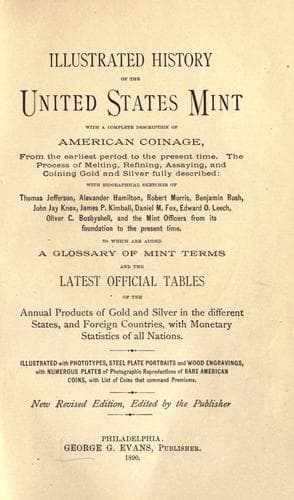
Illustrated history of the United States mint: with a complete description of American coinage, from the earliest period to the present time — John Shaqi
Illustrated history of the United States mint: with a complete description of American coinage, from the earliest period to the present time
History
Illustrated history of the United States mint: with a complete description of American coinage, from the earliest period to the present time
Coinage -- United States; Mints -- United States
Ancient and extensive as the use of money has been in all its numerous
forms and varied materials, it merely represented a property value which
had been created by manual labor and preserved by the organic action of
society. In a primitive state, herds of cattle and crops of grain were
almost the only forms of wealth; the natural tendency and disposition of
men to accumulate riches led them to fix a special value upon the metals,
as a durable and always available kind of property. When their value in
this way was generally recognized, the taxes and other revenues, created
by kings and other potentates, was collected in part or wholly in that
form of money. The government, to facilitate public business, stamped
the various pieces of metal with their weight and quality, as they were
received at the Treasury; and according to these stamps and marks, the
same pieces were paid out of the Treasury, and circulated among the
people at an authorized and fixed value. The next step was to reduce
current prices of metal to a uniform size, shape, and quality, value and
denomination, and make them, by special enactment, a legal tender for the
payment of all taxes or public dues.
Thus, a legalized currency of coined money was created, and the
exchangeable value of the various metals used for that purpose fully
established, to the great convenience of the world at large.
ANCIENT COINING.
The die for the obverse of the piece to be struck having been engraved,
so as to properly present the religious or national symbol used for a
device and whatever else was to be impressed upon the coin, was fixed
immovably in an anvil or pedestal, face upwards. The lumps or balls
of metal to be coined, having been made of a fixed and uniform weight
and nearly of an oblate sphere in form, were grasped in a peculiarly
constructed pair of tongs and laid upon the upturned die. A second
operative then placed a punch squarely upon the ball of metal; heavy
blows from a large hammer forced the punch down until the metal beneath
it had been forced into every part of the die, and a good impress
secured. In the meantime the punch would be imbedded in the lump of
metal, and on being withdrawn the reverse of the coin would show a rough
depression corresponding to the shape given the end of the punch, thereby
making an uneven surface and disfiguring the piece; punch marks gradually
developed into forms, and these forms combined with figures wrought into
artistic design, until, by degrees, the punch itself became a die, making
the reverse of each piece upon which it was used equal in every respect
to the obverse of which it was the opposite. This perfection of the
reverse was, however, secured at the expense of the effectiveness of the
punch for its original purpose.
Public-domain text, read in full here on John Shaqi.
Reviews
Reviews
No reviews yet
Be the first to share your thoughts on this work.
Join the Discussion
Join the discussion
Sign in to leave a comment or review.
Sign InorCreate an account