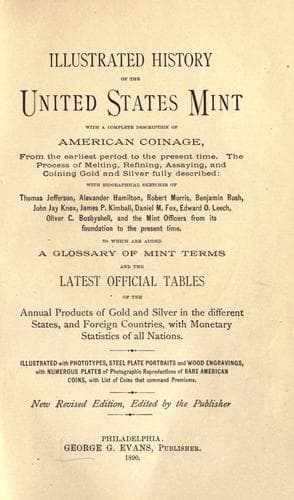
Illustrated history of the United States mint: with a complete description of American coinage, from the earliest period to the present time
History
Illustrated history of the United States mint: with a complete description of American coinage, from the earliest period to the present time
Coinage -- United States; Mints -- United States
ALEXANDER HAMILTON,
Statesman, orator, and financier, born in the West Indian island of
Nevis, 11th of January, 1757. His father was a Scotch merchant, and his
mother was the daughter of a French Huguenot. He was educated at King’s
College, N. Y. When he was 18 years of age he surprised the people by his
public speeches and pamphlets in favor of American independence. He was
commissioned Captain of a Company of Artillery in March, 1776, and served
with distinction at the battles of Long Island, White Plains, Trenton,
and Princeton, and was appointed Aid-de-camp and Private Secretary to
General Washington in March, 1777, and gained his special favor and
confidence in planning campaigns and devising means to support the
army. In 1782 he was elected a member of the Continental Congress, and
Washington expressed the opinion that no one excelled him in probity and
sterling virtue. He was an active member of an anti-slavery party in New
York, and offered a resolution in 1784, that every member of that society
should liberate his own slaves. He was a delegate to the convention
which met in Philadelphia in May, 1787, to form a Federal Constitution
and to promote the Union of the States, and it appears was the principal
author of the movement. Hamilton was appointed Secretary of the Treasury
in 1789, at the time the nation was burdened with a heavy debt, almost
destitute of credit, and on the verge of bankruptcy. The results of his
financial policy were the restoration of public credit, protection to
American industry, and a rapid revival of trade and commerce. He resigned
his office to resume his practice of law, January 31, 1795. He declined
the position of Chief Justice of the Supreme Court of the United States
previously tendered him. Washington testified his great esteem for
Hamilton by consulting him in the preparation of his Farewell Address, as
well as in many other acts of his noble career.
In 1804, Aaron Burr, presenting himself as a candidate for Governor
of New York, but Hamilton opposed his election expressing the opinion
that “Burr was a dangerous man and unfit to be trusted with power.”
The election of Gen. Lewis blasted the ambitious projects of Burr, who
insolently demanded an explanation of Hamilton, and finally challenged
him, Hamilton accepted the challenge, was mortally wounded at Weehawken,
and died July 12, 1804. His death was profoundly lamented throughout the
country.
NOTE.—His eldest son had been killed in a duel by a political adversary
about 1802. Mr. Hamilton was the principal author of the Federalist, and
the real father of our financial system. Immediately after adopting the
constitution, he strongly advocated the establishment of a Mint, so that
the New World would not be dependant on the Old for a circulating medium.
HON. JAMES PUTNAM KIMBALL,
PRESIDENT DIRECTOR OF ALL THE MINTS,
Public-domain text, read in full here on John Shaqi.
Reviews
Reviews
No reviews yet
Be the first to share your thoughts on this work.
Elsewhere in the archive
Join the Discussion
Join the discussion
Sign in to leave a comment or review.
Sign InorCreate an account