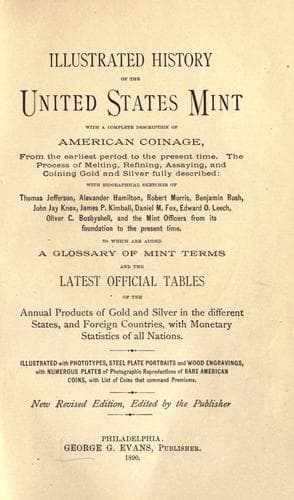
Illustrated history of the United States mint: with a complete description of American coinage, from the earliest period to the present time
History
Illustrated history of the United States mint: with a complete description of American coinage, from the earliest period to the present time
Coinage -- United States; Mints -- United States
One of the most graceful historical allusions is conveyed in the great
seal of Queen Anne, after the union of Scotland with England. A rose
and a thistle are growing on one stem, while, from above, the crown of
England sheds effulgence upon the tender young plant.
HUMOR PICTURED ON MEDALS.
The medal of George I., on the reverse, boastfully presents “the horse
of Brunswick” flying over the northwest of Europe, symbolizing the
Hanoverian succession. The overthrow of the “Invincible Armada” was the
occasion of a Dutch medal, showing the Hollanders richer in faith than
in art culture, for the obverse of this medal presents the church upon
a rock, in mid-ocean, while the reverse suggests the thought that the
luckless Spanish mariner was driving against the walls of the actual
building.
ARCHITECTURE INDEBTED TO COINS.
Architecture is largely indebted to coins, medals, and seals for accuracy
and data. We learn from the medal of Septimus Severus the faultless
beauty of the triumphal arch erected to celebrate his victory over
Arabs and Parthians. This medal was produced two centuries before the
Christian era, and is a marvel of art, for its perspective is wrought
in bas-relief—an achievement which was not again attained before the
execution of the celebrated Bronze Gates by Ghiberti, for the Baptistery
at Florence, A. D. 1425. This exhumed arch was excavated long after its
form and structure were familiar to men of letters through the medals.
LANGUAGE UPON COINS AND MEDALS.
The effect of coin on language is direct, and many words may be found
whose origin was a coin, such as Daric, a pure gold coin; Talent,
mental ability; Sterling, genuine, pure; while Guinea represents the
aristocratic element, and, though out of circulation long ago, “no one
who pretends to gentility in England would think of subscribing to any
charity or fashionable object by contributing the vulgar _pound_. An
extra shilling added to the _pound_ makes the _guinea_, and lifts the
subscriber at once into the aristocratic world.”
Copper is much preferred to gold for medals. Its firm, unchanging surface
accepts and retains finer lines than have yet been produced upon gold and
silver, and it offers no temptation to be thrown into the crucible.[1]
In the preparation of this work, I am much indebted to several gentlemen
connected with the United States Mint; also, to Messrs. R. Coulton Davis,
Ph.G., and E. Locke Mason, who are acknowledged authority on the subject
of numismatics.
If it shall be found useful to the public, and especially to visitors of
the Mint, it will be a source of satisfaction, and more than repay the
labor bestowed in its preparation.
G. G. E.
_Philadelphia, March 1, 1888._
THE UNITED STATES MINT.
Public-domain text, read in full here on John Shaqi.
Reviews
Reviews
No reviews yet
Be the first to share your thoughts on this work.
Join the Discussion
Join the discussion
Sign in to leave a comment or review.
Sign InorCreate an account