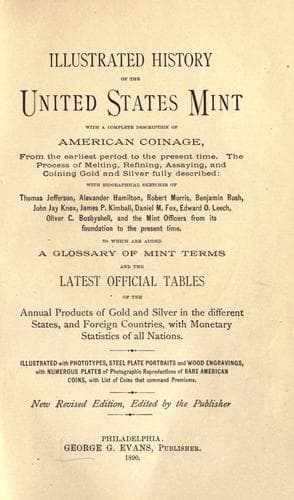
Illustrated history of the United States mint: with a complete description of American coinage, from the earliest period to the present time
History
Illustrated history of the United States mint: with a complete description of American coinage, from the earliest period to the present time
Coinage -- United States; Mints -- United States
Are not alone recorded; and as an example of a very different nature
may be cited the medals commemorating the destruction of Jerusalem, and
the whole series marking that episode, especially those classed “Judæa
capta.” They tell sadly of a people’s humiliation: the tied or chained
captive; the mocking goddess of victory, all made more real by reason
of the introduction, on the reverse of each piece, of a Jewess weeping
bitterly, and though she sits under a palm-tree, the national lament of
another captivity is forcibly recalled.
An interesting specimen of the series above mentioned was recently found
in the south of France called, “Judæa Navillas,” valuable particularly
because it strengthens Josephus’s assertion which had provoked some
comment, viz.: the fact of the escape of a large number of Jews from the
Romans, by means of ships, at Joppa.
Coins and medals mark the introduction of laws; for example, an old
Porcian coin gives the date of the “law of appeal,” under which, two
centuries and a half later, Paul appealed to Cæsar. Another relic dates
the introduction of the ballot-box; and a fact interesting to the
agriculturist is established by an old silver coin of Ptolemy, upon which
a man is represented cutting millet (a variety of Indian corn) with a
scythe. Religions have been promulgated by coins. Islamism says upon a
gold coin, “No God but God. Mohammed is the Prophet and God’s chosen
apostle.”
Persian coins, in mystic characters, symbolize the dreadful sacrifices
of the Fire-Worshippers. Henry VIII, with characteristic egotism, upon
a medal announces in Hebrew, Greek, and Latin: “Henry Eighth, King of
England, France, and Ireland; Defender of the Faith, and in the land of
England and Ireland, under Christ, the Supreme Head of the Church.”
COSTUMES ON COINS.
We also find stamped upon coins and medals the costumes of all ages, from
the golden net confining the soft tresses of the “sorceress of the Nile,”
and the gemmed robe of Queen Irene, to the broidered stomacher of Queen
Anne, and the stately ruff of Elizabeth of England.
In this connection may be mentioned the “bonnet piece” of Scotland,
a coin of the reign of James VI., which is extremely rare, one of
them having been sold for £41. The coin received its name from a
representation of the king upon it, with a curiously plaited hat or
bonnet which this monarch wore, a fashion that gave occasion for the
ballad, “Blue Bonnets over the Border.”
HERALDIC EMBLEMS
Are faithfully preserved through this medium; in truth, medalic honors
may be claimed as the very foundation of heraldic art. We discover
medals perpetuating revolutions, sieges, plots, and murders, etc. We
prefer directing attention to the fact that coins and medals are not
only the land-marks of history, but a favorite medium of the poetry of
all nations. Epics are thus preserved by the graver’s art in exceedingly
small space. Poets turn with confidence to old coins for symbol as well
as fact.
Public-domain text, read in full here on John Shaqi.
Reviews
Reviews
No reviews yet
Be the first to share your thoughts on this work.
Join the Discussion
Join the discussion
Sign in to leave a comment or review.
Sign InorCreate an account