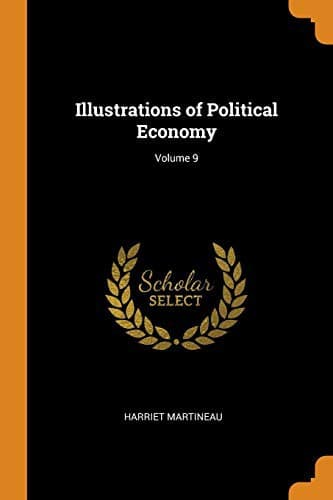
Illustrations of political economy, Volume 9 (of 9)Martineau, Harriet
General
Illustrations of political economy, Volume 9 (of 9)
Martineau, Harriet
Didactic fiction, English; Political fiction, English; Social problems -- Fiction
FARRERS OF BUDGE-ROW.
CHAPTER I.
BUDGE-ROW AGAIN!
“Pray open the window, Morgan,” said Jane Farrer to the old servant who
was assisting her to arrange for tea the room in which the family had
dined.
“Perhaps you don’t know, Ma’am, what a cutting wind it is. More like
December than March, Miss Jane; bitter enough to help on your
rheumatism, my dear.”
And Morgan paused, with her hand on the sash. Miss Farrer chose that the
room should be refreshed. She was aware that the scents from the shop
were at all times strong enough for the nerves of any one unaccustomed
to the atmosphere she lived in; and she did not wish that her brother
Henry should have to encounter in addition those which the dinner had
left behind. She tied a handkerchief over her head while the March wind
blew in chilly, and Morgan applied herself to light the fire. When the
dinner-table was set back against the wall, and the small Pembroke table
brought forward, and the sofa, with its brown cotton cover, wheeled
round, and the two candlesticks, with whole candles in them, placed in
front of the tea-tray, Miss Farrer thought she would go up into Henry’s
room, and see that all was right there, before she put off her black
stuff apron, and turned down the cuffs of her gown, and took her seat
beside the fire.
She tried to look at everything with the eyes she fancied her young
brother would bring from the university. She, who had lived for
five-and-thirty years in this very house, at the corner of Budge Row,
among this very furniture, could not reasonably expect to view either
the one or the other as it would appear to a youth of two-and-twenty,
who had lived in a far different scene, and among such companions as
Jane had no idea of. It was some vague notion of this improbability that
made her linger about Henry’s little apartment, and wonder whether he
would think she ought to have put up a stuff curtain before the window,
and whether he had been accustomed to a bit of carpet, and whether the
soap out of her father’s shop was such as he could use. Then came the
odd mixture of feelings,—that her father’s youngest son ought not to
dream of luxuries that his elder brother and sisters had not had,—and
yet that Henry was a scholar and a gentleman, and therefore unavoidably
held in awe by the family. When she reverted to the time, well
remembered, when she upheld the little fellow, and coaxed him to set one
tiny plump foot before the other, the idea of being now half afraid to
receive him made her smile and then sigh, and hope that good might come
of her father’s ambition to give a son of his a university education.
Before she had finished making herself as neat as usual, and rather more
dressed, she heard, amidst all the noises that came in from the narrow
bustling street, her own name called from the bottom of the stairs.
Public-domain text, read in full here on John Shaqi.
Reviews
Reviews
No reviews yet
Be the first to share your thoughts on this work.
Join the Discussion
Join the discussion
Sign in to leave a comment or review.
Sign InorCreate an account