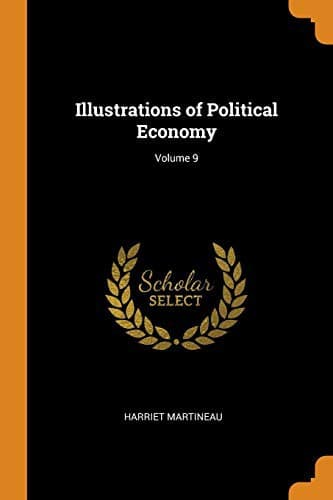
Illustrations of political economy, Volume 9 (of 9) — John Shaqi
Illustrations of political economy, Volume 9 (of 9)Martineau, Harriet
General
Illustrations of political economy, Volume 9 (of 9)
Martineau, Harriet
Didactic fiction, English; Political fiction, English; Social problems -- Fiction
“I’m coming, father!—It never can be Henry yet. The postman’s bell is
but just gone by, and the six o’clock cries are not all over; and there
sound the chimes. It is full five minutes’ walk from Lad-lane, too.
Perhaps there is something more to be done at the books: so I will carry
down my apron.—Why, Morgan, it is well I did not throw you down stairs.”
Morgan’s face, entrenched in its mob cap, was just visible in the
twilight, peeping into the room from the steep, narrow stair upon which
the chamber-door directly opened. She came to say that her master wanted
Miss Jane; that he was in a great hurry, and seemed to have some good
news to tell.
Mr. Farrer was bustling about, apparently in a state of great happiness.
His brown wig seemed to sit lightly on his crown; his shoes creaked very
actively; his half whistle betokened a light heart, and he poked the
fire as if he had forgotten how much coals were a bushel. He stretched
out his arms when his daughter came down with a look of inquiry, and
kissed her on either cheek, saying,
“I have news for thee, my dear. I say, Morgan, let us have plenty of
buttered toast,—plenty and hot. Well, Jenny,—life is short enough to
some folks. Of all people, who do you think are dead?”
Jane saw that it was nobody that she would be expected to grieve about.
She had fallen enough into her father’s way of thinking to conjecture
aright,—that some of the lot of lives with which her father and she were
joined in a tontine annuity had failed.
“Poor souls! Yes: Jerry Hill and his brother,—both gone together of a
fever, in the same house. Who would have thought it? Both younger lives
than mine, by some years. I have no doubt they thought, many a time,
that mine would be the first to fail. But this is a fine invention,—this
way of purchasing annuities,—though I was against it at first, as being
too much like a lottery for a sober man to venture upon. But, I say,
Jane, I hope you are glad I made you invest your money in this way. You
had a right to look to coming into their lives, sooner or later; but one
would hardly have expected it in my time; though, somehow, I always had
a notion it would turn out so.”
Jane’s colour had been much raised, from the first disclosure of the
news. She now asked whether these were not the last lives of the lot,
out of their own family;—whether her father’s, her brother Michael’s,
and her own were not the only ones now left.
“To be sure they are! We have the whole thing to ourselves from this
time. I think the minister will be for sending Michael and me to the
wars, to have us killed off; though I hope, in that case, you would live
on and on, and enjoy your own for many a year, to disappoint him. But,
to be sure,” said the old man, checking his exultation as he saw his
daughter look grave, “life is a very uncertain thing, as we may see by
what has just happened.”
“I am sure it is the last thing I thought of,” observed Jane.
Public-domain text, read in full here on John Shaqi.
Reviews
Reviews
No reviews yet
Be the first to share your thoughts on this work.
Join the Discussion
Join the discussion
Sign in to leave a comment or review.
Sign InorCreate an account