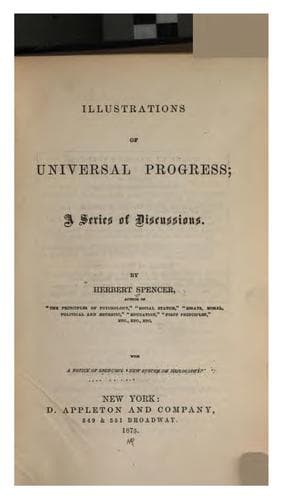
Illustrations of Universal Progress: A Series of DiscussionsSpencer, Herbert
Philosophy
Illustrations of Universal Progress: A Series of Discussions
Spencer, Herbert
Philosophy; Political science; Science
Though we find here some unwarranted assumptions, as well as some grave
omissions, yet this part (Laws of the Knowable) may be considered, upon
the whole, as a fine specimen of scientific reasoning. Considerable
space is devoted to the "Law of Evolution" the discovery of which is
the author's chief claim to originality, and certainly evinces great
power of generalization. To quote the abstract definition without a
full statement of the inductions from which it is derived would convey
no fair impression of the breadth and strength of the thought which it
epitomizes. Of Mr. Spencer's general characteristics as a writer, we
may observe that his style is marked by great purity, clearness, and
force; though it is somewhat diffuse, and the abstract nature of some
of his topics occasionally renders his thought difficult of
apprehension. His treatment of his subjects is generally thorough and
sometimes exhaustive; his arguments are always ingenious if not always
convincing; his illustrations are drawn from almost every accessible
field of human knowledge, and his method of "putting things" is such as
to make the most of his materials. He is undoubtedly entitled to a high
rank among the speculative and philosophic writers of the present
day....
In Mr. Spencer we have the example of a positivist, who does not treat
the subject of religion with supercilious neglect, and who illustrates
by his own method of reasoning upon the highest objects of human
thought, the value of those metaphysical studies which it is so much
the fashion of his school to decry. For both these reasons the volume,
which we now propose to examine, deserves the careful attention of the
theologian who desires to know what one of the strongest thinkers of
his school, commonly thought atheistic in its tendencies, can say in
behalf of our ultimate religious ideas. For if we mistake not, in spite
of the very negative character of his own results, he has furnished
some strong arguments for the doctrine of a positive Christian
theology. We shall be mistaken if we expect to find him carelessly
passing these matters by (religious faith and theological science) as
in all respects beyond knowledge and of no practical concern. On the
contrary, he gives them profound attention, and arrives at conclusions
in regard to them which even the Christian theologian must allow to
contain a large measure of truth. While showing the _unsearchable
nature_ of the ultimate facts on which religion depends, he
demonstrates their _real existence_ and their great importance.... In
answering these questions Mr. Spencer has, we think, arrived nearer to
a true philosophy than either Hamilton or Mansel. At least he has
indicated in a more satisfactory manner than they have done, the
positive datum of consciousness that the unconditioned, though
inscrutable, _exists_. It may be said that Mr. Spencer is not
chargeable with excluding God from the universe, or denying all
Public-domain text, read in full here on John Shaqi.
Reviews
Reviews
No reviews yet
Be the first to share your thoughts on this work.
Join the Discussion
Join the discussion
Sign in to leave a comment or review.
Sign InorCreate an account