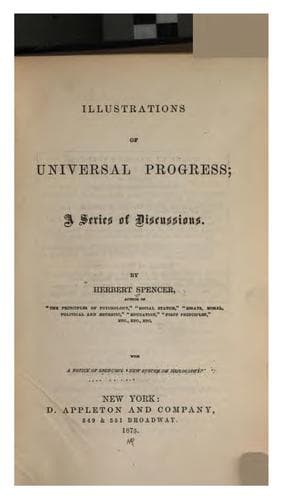
Illustrations of Universal Progress: A Series of DiscussionsSpencer, Herbert
Philosophy
Illustrations of Universal Progress: A Series of Discussions
Spencer, Herbert
Philosophy; Political science; Science
Indeed, as this observation suggests, it will be well, before tracing the
mode in which exact science finally emerges from the merely approximate
judgments of the senses, and showing the non-serial evolution of its
divisions, to note the non-serial character of those preliminary processes
of which all after development is a continuation. On re-considering them it
will be seen that not only are they divergent growths from a common
root,--not only are they simultaneous in their progress; but that they are
mutual aids; and that none can advance without the rest. That completeness
of classification for which the unfolding of the perceptions paves the way,
is impossible without a corresponding progress in language, by which
greater varieties of objects are thinkable and expressible. On the one hand
it is impossible to carry classification far without names by which to
designate the classes; and on the other hand it is impossible to make
language faster than things are classified.
Again, the multiplication of classes and the consequent narrowing of each
class, itself involves a greater likeness among the things classed
together; and the consequent approach towards the notion of complete
likeness itself allows classification to be carried higher. Moreover,
classification necessarily advances _pari passu_ with rationality--the
classification of _things_ with the classification of _relations_. For
things that belong to the same class are, by implication, things of which
the properties and modes of behaviour--the co-existences and sequences--are
more or less the same; and the recognition of this sameness of
co-existences and sequences is reasoning. Whence it follows that the
advance of classification is necessarily proportionate to the advance of
generalizations. Yet further, the notion of _likeness_, both in things and
relations, simultaneously evolves by one process of culture the ideas of
_equality_ of things and _equality_ of relations; which are the respective
bases of exact concrete reasoning and exact abstract reasoning--Mathematics
and Logic. And once more, this idea of equality, in the very process of
being formed, necessarily gives origin to two series of relations--those of
magnitude and those of number: from which arise geometry and the calculus.
Thus the process throughout is one of perpetual subdivision and perpetual
intercommunication of the divisions. From the very first there has been
that _consensus_ of different kinds of knowledge, answering to the
_consensus_ of the intellectual faculties, which, as already said, must
exist among the sciences.
Let us now go on to observe how, out of the notions of _equality_ and
_number_, as arrived at in the manner described, there gradually arose the
elements of quantitative prevision.
Public-domain text, read in full here on John Shaqi.
Reviews
Reviews
No reviews yet
Be the first to share your thoughts on this work.
Elsewhere in the archive
Join the Discussion
Join the discussion
Sign in to leave a comment or review.
Sign InorCreate an account