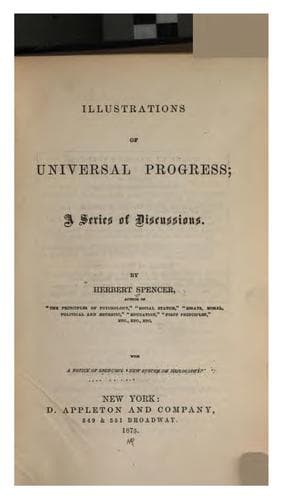
Illustrations of Universal Progress: A Series of DiscussionsSpencer, Herbert
Philosophy
Illustrations of Universal Progress: A Series of Discussions
Spencer, Herbert
Philosophy; Political science; Science
To answer the question of the likelihood of the permanence of Mr.
Mill's philosophic reign, ... we should have to take account, among
other things, of the differences from Mr. Mill already shown by the
extraordinarily able and peculiarly original thinker whose name we have
associated with Mr. Mill's at the head of this article. We may take
occasion, at another time, to call attention to these speculations of
Mr. Herbert Spencer, whose works in the meantime, and especially that
new one whose title we have cited, we recommend to all those select
readers whose appreciation of masterly exposition, and great reach and
boldness of generalization, does not depend on their mere disposition
to agree with the doctrines propounded.
_From the British Quarterly Review._
Complete in itself, it is at the same time but a part of a whole,
which, if it should be constructed in proportion, will be ten times as
great. For these First Principles are merely the foundation of a system
of philosophy, bolder, more elaborate and comprehensive, perhaps, than
any other which has been hitherto designed in England.... Widely as it
will be seen we differ from the author on some points, we very
sincerely hope he may succeed in accomplishing the bold and magnificent
project he has mapped out.
_From the Cornhill Magazine._
Our "Survey," superficial as it is, must include at least the mention
of a work so lofty in aim, and so remarkable in execution as the system
of Philosophy which Mr. Herbert Spencer is issuing to subscribers....
In spite of all dissidence respecting the conclusions, the serious
reader will applaud the profound earnestness and thoroughness with
which these conclusions are advocated; the universal scientific
knowledge brought to bear on them by way of illustration, and the acute
and subtle thinking displayed in every chapter.
_From the Parthenon._
By these books he has wedged his way into fame in a manner distinctly
original, and curiously marked.... There is a peculiar charm in this
author's style, in that it sacrifices to no common taste, while at the
same time it makes the most abstruse questions intelligible.... The
book, if it is to be noticed with the slightest degree of fairness,
requires to be read and re-read, to be studied apart from itself and
with itself. For whatever may be its ultimate fate--although as the
ages go on it shall become but as the lispings of a little child, a
little more educated than other lisping children of the same time--this
is certain, that, as a book addressed to the present, it lifts the mind
far above the ordinary range of thought, suggests new associations,
arranges chaotic pictures, strikes often a broad harmony, and even
moves the heart by an intellectual struggle as passionless as fate, but
as irresistible as time.
_From the Critic._
Public-domain text, read in full here on John Shaqi.
Reviews
Reviews
No reviews yet
Be the first to share your thoughts on this work.
Join the Discussion
Join the discussion
Sign in to leave a comment or review.
Sign InorCreate an account