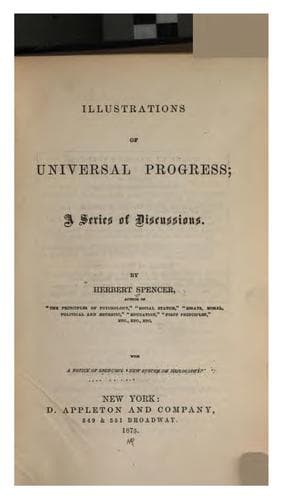
Illustrations of Universal Progress: A Series of DiscussionsSpencer, Herbert
Philosophy
Illustrations of Universal Progress: A Series of Discussions
Spencer, Herbert
Philosophy; Political science; Science
Meanwhile, physics had been carrying further that progress without which,
as just shown, rational mechanics could not be disentangled. In
hydrostatics, Stevinus had extended and applied the discovery of
Archimedes. Torricelli had proved atmospheric pressure, "by showing that
this pressure sustained different liquids at heights inversely proportional
to their densities;" and Pascal "established the necessary diminution of
this pressure at increasing heights in the atmosphere:" discoveries which
in part reduced this branch of science to a quantitative form. Something
had been done by Daniel Bernoulli towards the dynamics of fluids. The
thermometer had been invented; and a number of small generalizations
reached by it. Huyghens and Newton had made considerable progress in
optics; Newton had approximately calculated the rate of transmission of
sound; and the continental mathematicians had succeeded in determining some
of the laws of sonorous vibrations. Magnetism and electricity had been
considerably advanced by Gilbert. Chemistry had got as far as the mutual
neutralization of acids and alkalies. And Leonardo da Vinci had advanced in
geology to the conception of the deposition of marine strata as the origin
of fossils. Our present purpose does not require that we should give
particulars. All that it here concerns us to do is to illustrate the
_consensus_ subsisting in this stage of growth, and afterwards. Let as look
at a few cases.
The theoretic law of the velocity of sound enunciated by Newton on purely
mechanical considerations, was found wrong by one-sixth. The error remained
unaccounted for until the time of Laplace, who, suspecting that the heat
disengaged by the compression of the undulating strata of the air, gave
additional elasticity, and so produced the difference, made the needful
calculations and found he was right. Thus acoustics was arrested until
thermology overtook and aided it. When Boyle and Marriot had discovered the
relation between the density of gases and the pressures they are subject
to; and when it thus became possible to calculate the rate of decreasing
density in the upper parts of the atmosphere; it also became possible to
make approximate tables of the atmospheric refraction of light. Thus
optics, and with it astronomy, advanced with barology. After the discovery
of atmospheric pressure had led to the invention of the air-pump by Otto
Guericke; and after it had become known that evaporation increases in
rapidity as atmospheric pressure decreases; it became possible for Leslie,
by evaporation in a vacuum, to produce the greatest cold known; and so to
extend our knowledge of thermology by showing that there is no zero within
reach of our researches. When Fourier had determined the laws of conduction
of heat, and when the Earth's temperature had been found to increase below
the surface one degree in every forty yards, there were data for inferring
Public-domain text, read in full here on John Shaqi.
Reviews
Reviews
No reviews yet
Be the first to share your thoughts on this work.
Elsewhere in the archive
Join the Discussion
Join the discussion
Sign in to leave a comment or review.
Sign InorCreate an account