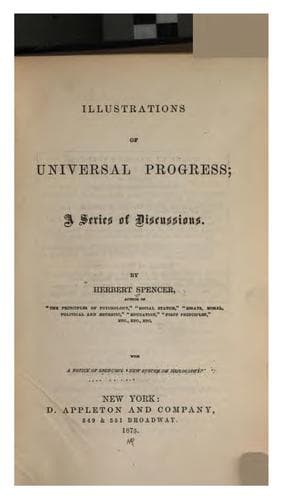
Illustrations of Universal Progress: A Series of Discussions — John Shaqi
Illustrations of Universal Progress: A Series of DiscussionsSpencer, Herbert
Philosophy
Illustrations of Universal Progress: A Series of Discussions
Spencer, Herbert
Philosophy; Political science; Science
His system is designed to embrace five works; each a distinct treatise, but
all closely connected in plan, and treating of the following subjects in
the order presented: 1st, First Principles; 2d, Principles of Biology; 3d,
Principles of Psychology; 4th, Principles of Sociology; 5th, Principles of
Morality. The opening work of the series--_First Principles_--though
somewhat of an introductory character, is an independent and completed
argument. It consists of two parts: first, "The Unknowable," and second,
"The Laws of the Knowable." Unattractive as these titles may seem, they
indicate a discussion of great originality and transcendent interest.
When public consideration is invited to a system of philosophy so extended
as to comprehend the entire scheme of nature and humanity, and so bold as
to deal with them in the ripest spirit of science, it is natural that many
should ask at the outset how the author stands related to the problem of
Religion. Mr. Spencer finds this the preliminary question of his
philosophy, and engages with it at the threshold of his undertaking. Before
attempting to work out a philosophical scheme, he sees that it is at first
necessary to find how far Philosophy can go and where she must stop--the
necessary limits of human knowledge, or the circle which bounds all
rational and legitimate investigation; and this opens at once the profound
and imminent question of the spheres and relation of Religion and Science.
Mr. Spencer is a leading representative of that school of thinkers which
holds that, as man is finite, he can grasp and know only the finite;--that
by the inexorable conditions of thought all real knowledge is relative and
phenomenal, and hence that we cannot go behind phenomena to find the
ultimate causes and solve the ultimate mystery of being. In such assertions
as that "God cannot by any searching be found out;" that "a God understood
would be no God at all;" and that "to think God _is_ as we think Him to be
is blasphemy," we see the recognition of this idea of the inscrutableness
of the Absolute Cause. The doctrine itself is neither new nor limited to a
few exceptional thinkers. It is widely affirmed by enlightened science, and
pervades nearly all the cultivated theology of the present day. Sir William
Hamilton and Dr. Mansel are among its recent and ablest expounders. "With
the exception," says Sir William Hamilton, "of a few late absolutist
theorizers in Germany, this is perhaps the truth of all others most
harmoniously reechoed by every philosopher of every school;" and among
these he names Protagoras, Aristotle, St. Augustine, Melanchthon, Scaliger,
Bacon, Spinoza, Newton, and Kant.
Public-domain text, read in full here on John Shaqi.
Reviews
Reviews
No reviews yet
Be the first to share your thoughts on this work.
Join the Discussion
Join the discussion
Sign in to leave a comment or review.
Sign InorCreate an account