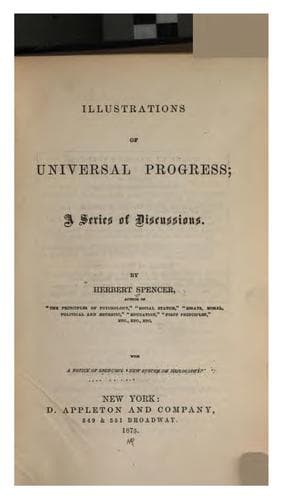
Illustrations of Universal Progress: A Series of Discussions — John Shaqi
Illustrations of Universal Progress: A Series of DiscussionsSpencer, Herbert
Philosophy
Illustrations of Universal Progress: A Series of Discussions
Spencer, Herbert
Philosophy; Political science; Science
But though Mr. Spencer accepts this doctrine, he has not left it where he
found it. The world is indebted to him for having advanced the argument to
a higher and grander conclusion--a conclusion which changes the
philosophical aspect of the whole question, and involves the profoundest
consequences. Hamilton and Mansel bring us, by their inexorable logic, to
the result that we can neither know nor conceive the Infinite, and that
every attempt to do so involves us in contradiction and absurdity; but
having reached this vast negation, their logic and philosophy break down.
Accepting their conclusions as far as they go, Mr. Spencer maintains the
utter incompleteness of their reasoning, and, pushing the inquiry still
farther, he demonstrates that though we cannot grasp the Infinite in
_thought_, we can realize it in _consciousness_. He shows that though by
the laws of thinking we are rigorously prevented from forming a
_conception_ of that Incomprehensible, Omnipotent Power by which we are
acted upon in all phenomena, yet we are, by the laws of thought, equally
prevented from ridding ourselves of the _consciousness_ of this Power. He
proves that this consciousness of a Supreme Cause is not _negative_, but
_positive_--that it is indestructible, and has a higher certainty than any
other belief whatever. The Unknowable, then, in the view of Mr. Spencer, is
not a mere term of negation, nor a word employed only to express our
ignorance, but it means that Infinite Reality, that Supreme but Inscrutable
Cause, of which the universe is but a manifestation, and which has an
ever-present disclosure in human consciousness.
Having thus found an indestructible basis in human nature for the religious
sentiment, Mr. Spencer next shows that all religions rest upon this
foundation, and contain a fundamental verity--a soul of truth, which
remains when their conflicting doctrines and discordant peculiarities are
mutually cancelled. In the lower and grosser forms of religion this truth
is but dimly discerned, but becomes ever clearer the more highly the
religion is developed, surviving every change, and remaining untouched by
the severest criticism.
Public-domain text, read in full here on John Shaqi.
Reviews
Reviews
No reviews yet
Be the first to share your thoughts on this work.
Join the Discussion
Join the discussion
Sign in to leave a comment or review.
Sign InorCreate an account