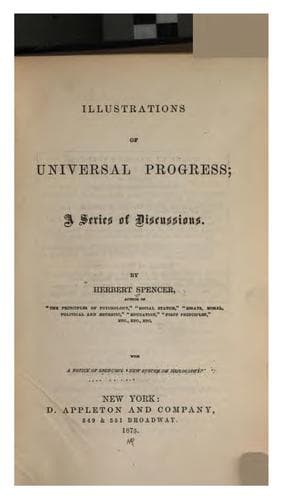
Illustrations of Universal Progress: A Series of DiscussionsSpencer, Herbert
Philosophy
Illustrations of Universal Progress: A Series of Discussions
Spencer, Herbert
Philosophy; Political science; Science
On the other hand, the worthlessness of the assumption that we have
discovered the earliest, or anything like the earliest, organic remains, is
becoming equally clear. That the oldest known sedimentary rocks have been
greatly changed by igneous action, and that still older ones have been
totally transformed by it, is becoming undeniable. And the fact that
sedimentary strata earlier than any we know, have been melted up, being
admitted, it must also be admitted that we cannot say how far back in time
this destruction of sedimentary strata has been going on. Thus it is
manifest that the title, _Palaeozoic_, as applied to the earliest known
fossiliferous strata, involves a _petitio principii_; and that, for aught
we know to the contrary, only the last few chapters of the Earth's
biological history may have come down to us. On neither side, therefore, is
the evidence conclusive. Nevertheless we cannot but think that, scanty as
they are, the facts, taken altogether, tend to show both that the more
heterogeneous organisms have been evolved in the later geologic periods,
and that Life in general has been more heterogeneously manifested as time
has advanced. Let us cite, in illustration, the one case of the
_vertebrata_. The earliest known vertebrate remains are those of Fishes;
and Fishes are the most homogeneous of the vertebrata. Later and more
heterogeneous are Reptiles. Later still, and more heterogeneous still, are
Mammals and Birds. If it be said, as it may fairly be said, that the
Palaeozoic deposits, not being estuary deposits, are not likely to contain
the remains of terrestrial vertebrata, which may nevertheless have existed
at that era, we reply that we are merely pointing to the leading facts,
_such as they are_.
Public-domain text, read in full here on John Shaqi.
Reviews
Reviews
No reviews yet
Be the first to share your thoughts on this work.
Join the Discussion
Join the discussion
Sign in to leave a comment or review.
Sign InorCreate an account