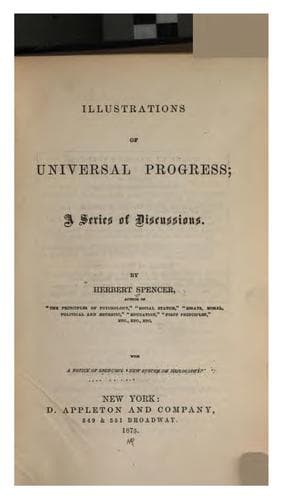
Illustrations of Universal Progress: A Series of DiscussionsSpencer, Herbert
Philosophy
Illustrations of Universal Progress: A Series of Discussions
Spencer, Herbert
Philosophy; Political science; Science
But to avoid any such criticism, let us take the mammalian subdivision
only. The earliest known remains of mammals are those of small marsupials,
which are the lowest of the mammalian type; while, conversely, the highest
of the mammalian type--Man--is the most recent. The evidence that the
vertebrate fauna, as a whole, has become more heterogeneous, is
considerably stronger. To the argument that the vertebrate fauna of the
Palaeozoic period, consisting, so far as we know, entirely of Fishes, was
less heterogeneous than the modern vertebrate fauna, which includes
Reptiles, Birds, and Mammals, of multitudinous genera, it may be replied,
as before, that estuary deposits of the Palaeozoic period, could we find
them, might contain other orders of vertebrata. But no such reply can be
made to the argument that whereas the marine vertebrata of the Palaeozoic
period consisted entirely of cartilaginous fishes, the marine vertebrata of
later periods include numerous genera of osseous fishes; and that,
therefore, the later marine vertebrate faunas are more heterogeneous than
the oldest known one. Nor, again, can any such reply be made to the fact
that there are far more numerous orders and genera of mammalian remains in
the tertiary formations than in the secondary formations. Did we wish
merely to make out the best case, we might dwell upon the opinion of Dr.
Carpenter, who says that "the general facts of Palaeontology appear to
sanction the belief, that _the same plan_ may be traced out in what may be
called _the general life of the globe_, as in _the individual life_ of
every one of the forms of organized being which now people it." Or we might
quote, as decisive, the judgment of Professor Owen, who holds that the
earlier examples of each group of creatures severally departed less widely
from archetypal generality than the later ones--were severally less unlike
the fundamental form common to the group as a whole; that is to
say--constituted a less heterogeneous group of creatures; and who further
upholds the doctrine of a biological progression. But in deference to an
authority for whom we have the highest respect, who considers that the
evidence at present obtained does not justify a verdict either way, we are
content to leave the question open.
Whether an advance from the homogeneous to the heterogeneous is or is not
displayed in the biological history of the globe, it is clearly enough
displayed in the progress of the latest and most heterogeneous
creature--Man. It is alike true that, during the period in which the Earth
has been peopled, the human organism has grown more heterogeneous among the
civilized divisions of the species; and that the species, as a whole, has
been growing more heterogeneous in virtue of the multiplication of races
and the differentiation of these races from each other.
Public-domain text, read in full here on John Shaqi.
Reviews
Reviews
No reviews yet
Be the first to share your thoughts on this work.
Join the Discussion
Join the discussion
Sign in to leave a comment or review.
Sign InorCreate an account