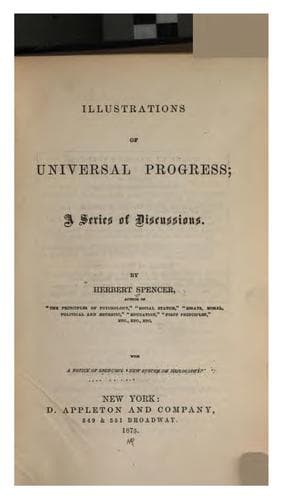
Illustrations of Universal Progress: A Series of DiscussionsSpencer, Herbert
Philosophy
Illustrations of Universal Progress: A Series of Discussions
Spencer, Herbert
Philosophy; Political science; Science
new variety arising within these few generations; and that, if we may trust
to the description of observers, we are likely soon to have another such
example in Australia.
On passing from Humanity under its individual form, to Humanity as socially
embodied, we find the general law still more variously exemplified. The
change from the homogeneous to the heterogeneous is displayed equally in
the progress of civilization as a whole, and in the progress of every tribe
or nation; and is still going on with increasing rapidity. As we see in
existing barbarous tribes, society in its first and lowest form is a
homogeneous aggregation of individuals having like powers and like
functions: the only marked difference of function being that which
accompanies difference of sex. Every man is warrior, hunter, fisherman,
tool-maker, builder; every woman performs the same drudgeries; every family
is self-sufficing, and save for purposes of aggression and defence, might
as well live apart from the rest. Very early, however, in the process of
social evolution, we find an incipient differentiation between the
governing and the governed. Some kind of chieftainship seems coeval with
the first advance from the state of separate wandering families to that of
a nomadic tribe. The authority of the strongest makes itself felt among a
body of savages as in a herd of animals, or a posse of schoolboys. At
first, however, it is indefinite, uncertain; is shared by others of
scarcely inferior power; and is unaccompanied by any difference in
occupation or style of living: the first ruler kills his own game, makes
his own weapons, builds his own hut, and economically considered, does not
differ from others of his tribe. Gradually, as the tribe progresses, the
contrast between the governing and the governed grows more decided. Supreme
power becomes hereditary in one family; the head of that family, ceasing to
provide for his own wants, is served by others; and he begins to assume the
sole office of ruling.
Public-domain text, read in full here on John Shaqi.
Reviews
Reviews
No reviews yet
Be the first to share your thoughts on this work.
Join the Discussion
Join the discussion
Sign in to leave a comment or review.
Sign InorCreate an account