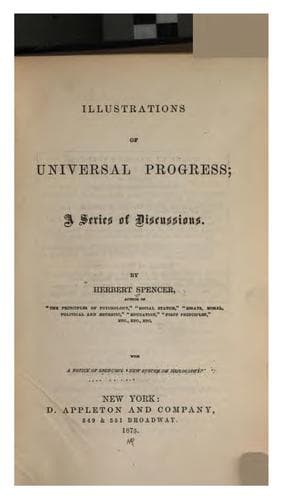
Illustrations of Universal Progress: A Series of DiscussionsSpencer, Herbert
Philosophy
Illustrations of Universal Progress: A Series of Discussions
Spencer, Herbert
Philosophy; Political science; Science
At the same time there has been arising a co-ordinate species of
government--that of Religion. As all ancient records and traditions prove,
the earliest rulers are regarded as divine personages. The maxims and
commands they uttered during their lives are held sacred after their
deaths, and are enforced by their divinely-descended successors; who in
their turns are promoted to the pantheon of the race, there to be
worshipped and propitiated along with their predecessors: the most ancient
of whom is the supreme god, and the rest subordinate gods. For a long time
these connate forms of government--civil and religious--continue closely
associated. For many generations the king continues to be the chief priest,
and the priesthood to be members of the royal race. For many ages religious
law continues to contain more or less of civil regulation, and civil law to
possess more or less of religious sanction; and even among the most
advanced nations these two controlling agencies are by no means completely
differentiated from each other.
Having a common root with these, and gradually diverging from them, we find
yet another controlling agency--that of Manners or ceremonial usages. All
titles of honour are originally the names of the god-king; afterwards of
God and the king; still later of persons of high rank; and finally come,
some of them, to be used between man and man. All forms of complimentary
address were at first the expressions of submission from prisoners to their
conqueror, or from subjects to their ruler, either human or
divine--expressions that were afterwards used to propitiate subordinate
authorities, and slowly descended into ordinary intercourse. All modes of
salutation were once obeisances made before the monarch and used in worship
of him after his death. Presently others of the god-descended race were
similarly saluted; and by degrees some of the salutations have become the
due of all.[A] Thus, no sooner does the originally homogeneous social mass
differentiate into the governed and the governing parts, than this last
exhibits an incipient differentiation into religious and secular--Church
and State; while at the same time there begins to be differentiated from
both, that less definite species of government which rules our daily
intercourse--a species of government which, as we may see in heralds'
colleges, in books of the peerage, in masters of ceremonies, is not without
a certain embodiment of its own. Each of these is itself subject to
successive differentiations. In the course of ages, there arises, as among
ourselves, a highly complex political organization of monarch, ministers,
lords and commons, with their subordinate administrative departments,
courts of justice, revenue offices, &c., supplemented in the provinces by
municipal governments, county governments, parish or union governments--all
of them more or less elaborated. By its side there grows up a highly
Public-domain text, read in full here on John Shaqi.
Reviews
Reviews
No reviews yet
Be the first to share your thoughts on this work.
Join the Discussion
Join the discussion
Sign in to leave a comment or review.
Sign InorCreate an account