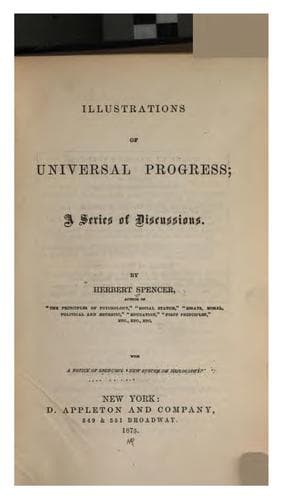
Illustrations of Universal Progress: A Series of Discussions — John Shaqi
Illustrations of Universal Progress: A Series of DiscussionsSpencer, Herbert
Philosophy
Illustrations of Universal Progress: A Series of Discussions
Spencer, Herbert
Philosophy; Political science; Science
The lowest form of language is the exclamation, by which an entire idea is
vaguely conveyed through a single sound; as among the lower animals. That
human language ever consisted solely of exclamations, and so was strictly
homogeneous in respect of its parts of speech, we have no evidence. But
that language can be traced down to a form in which nouns and verbs are its
only elements, is an established fact. In the gradual multiplication of
parts of speech out of these primary ones--in the differentiation of verbs
into active and passive, of nouns into abstract and concrete--in the rise
of distinctions of mood, tense, person, of number and case--in the
formation of auxiliary verbs, of adjectives, adverbs, pronouns,
prepositions, articles--in the divergence of those orders, genera, species,
and varieties of parts of speech by which civilized races express minute
modifications of meaning--we see a change from the homogeneous to the
heterogeneous. And it may be remarked, in passing, that it is more
especially in virtue of having carried this subdivision of function to a
greater extent and completeness, that the English language is superior to
all others.
Another aspect under which we may trace the development of language is the
differentiation of words of allied meanings. Philology early disclosed the
truth that in all languages words may be grouped into families having a
common ancestry. An aboriginal name applied indiscriminately to each of an
extensive and ill-defined class of things or actions, presently undergoes
modifications by which the chief divisions of the class are expressed.
These several names springing from the primitive root, themselves become
the parents of other names still further modified. And by the aid of those
systematic modes which presently arise, of making derivations and forming
compound terms expressing still smaller distinctions, there is finally
developed a tribe of words so heterogeneous in sound and meaning, that to
the uninitiated it seems incredible that they should have had a common
origin. Meanwhile from other roots there are being evolved other such
tribes, until there results a language of some sixty thousand or more
unlike words, signifying as many unlike objects, qualities, acts.
Public-domain text, read in full here on John Shaqi.
Reviews
Reviews
No reviews yet
Be the first to share your thoughts on this work.
Join the Discussion
Join the discussion
Sign in to leave a comment or review.
Sign InorCreate an account