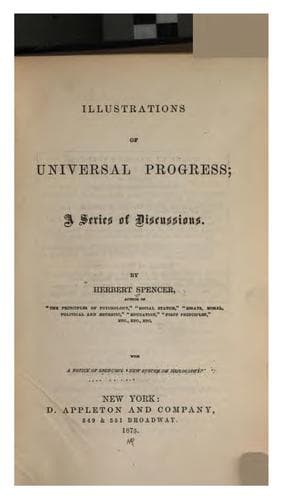
Illustrations of Universal Progress: A Series of DiscussionsSpencer, Herbert
Philosophy
Illustrations of Universal Progress: A Series of Discussions
Spencer, Herbert
Philosophy; Political science; Science
Long after considerable progress has been made in the division of labour
among different classes of workers, there is still little or no division of
labour among the widely separated parts of the community; the nation
continues comparatively homogeneous in the respect that in each district
the same occupations are pursued. But when roads and other means of transit
become numerous and good, the different districts begin to assume different
functions, and to become mutually dependent. The calico manufacture locates
itself in this county, the woollen-cloth manufacture in that; silks are
produced here, lace there; stockings in one place, shoes in another;
pottery, hardware, cutlery, come to have their special towns; and
ultimately every locality becomes more or less distinguished from the rest
by the leading occupation carried on in it. Nay, more, this subdivision of
functions shows itself not only among the different parts of the same
nation, but among different nations. That exchange of commodities which
free-trade promises so greatly to increase, will ultimately have the effect
of specializing, in a greater or less degree, the industry of each people.
So that beginning with a barbarous tribe, almost if not quite homogeneous
in the functions of its members, the progress has been, and still is,
towards an economic aggregation of the whole human race; growing ever more
heterogeneous in respect of the separate functions assumed by separate
nations, the separate functions assumed by the local sections of each
nation, the separate functions assumed by the many kinds of makers and
traders in each town, and the separate functions assumed by the workers
united in producing each commodity.
Not only is the law thus clearly exemplified in the evolution of the social
organism, but it is exemplified with equal clearness in the evolution of
all products of human thought and action, whether concrete or abstract,
real or ideal. Let us take Language as our first illustration.
Public-domain text, read in full here on John Shaqi.
Reviews
Reviews
No reviews yet
Be the first to share your thoughts on this work.
Join the Discussion
Join the discussion
Sign in to leave a comment or review.
Sign InorCreate an account