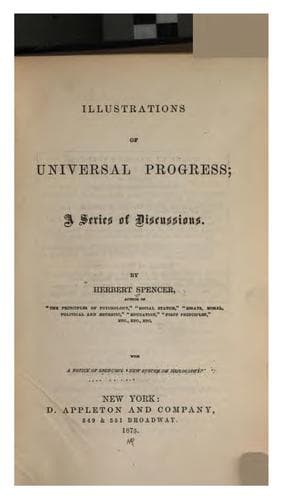
Illustrations of Universal Progress: A Series of DiscussionsSpencer, Herbert
Philosophy
Illustrations of Universal Progress: A Series of Discussions
Spencer, Herbert
Philosophy; Political science; Science
But doubtless the reader is already weary of illustrations; and our promise
has been amply fulfilled. We believe we have shown beyond question, that
that which the German physiologists have found to be the law of organic
development, is the law of all development. The advance from the simple to
the complex, through a process of successive differentiations, is seen
alike in the earliest changes of the Universe to which we can reason our
way back; and in the earliest changes which we can inductively establish;
it is seen in the geologic and climatic evolution of the Earth, and of
every single organism on its surface; it is seen in the evolution of
Humanity, whether contemplated in the civilized individual, or in the
aggregation of races; it is seen in the evolution of Society in respect
alike of its political, its religious, and its economical organization; and
it is seen in the evolution of all those endless concrete and abstract
products of human activity which constitute the environment of our daily
life. From the remotest past which Science can fathom, up to the novelties
of yesterday, that in which Progress essentially consists, is the
transformation of the homogeneous into the heterogeneous.
* * * * *
And now, from this uniformity of procedure, may we not infer some
fundamental necessity whence it results? May we not rationally seek for
some all-pervading principle which determines this all-pervading process of
things? Does not the universality of the _law_ imply a universal _cause_?
That we can fathom such cause, noumenally considered, is not to be
supposed. To do this would be to solve that ultimate mystery which must
ever transcend human intelligence. But it still may be possible for us to
reduce the law of all Progress, above established, from the condition of an
empirical generalization, to the condition of a rational generalization.
Just as it was possible to interpret Kepler's laws as necessary
consequences of the law of gravitation; so it may be possible to interpret
this law of Progress, in its multiform manifestations, as the necessary
consequence of some similarly universal principle. As gravitation was
assignable as the _cause_ of each of the groups of phenomena which Kepler
formulated; so may some equally simple attribute of things be assignable as
the cause of each of the groups of phenomena formulated in the foregoing
pages. We may be able to affiliate all these varied and complex evolutions
of the homogeneous into the heterogeneous, upon certain simple facts of
immediate experience, which, in virtue of endless repetition, we regard as
necessary.
Public-domain text, read in full here on John Shaqi.
Reviews
Reviews
No reviews yet
Be the first to share your thoughts on this work.
Join the Discussion
Join the discussion
Sign in to leave a comment or review.
Sign InorCreate an account