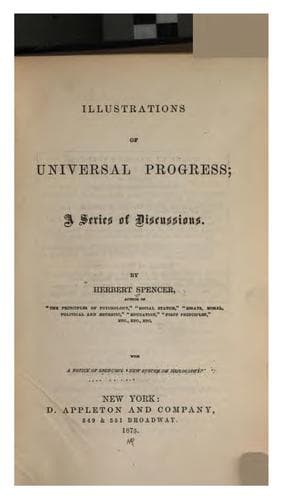
Illustrations of Universal Progress: A Series of DiscussionsSpencer, Herbert
Philosophy
Illustrations of Universal Progress: A Series of Discussions
Spencer, Herbert
Philosophy; Political science; Science
The probability of a common cause, and the possibility of formulating it,
being granted, it will be well, before going further, to consider what must
be the general characteristics of such cause, and in what direction we
ought to look for it. We can with certainty predict that it has a high
degree of generality; seeing that it is common to such infinitely varied
phenomena: just in proportion to the universality of its application must
be the abstractness of its character. We need not expect to see in it an
obvious solution of this or that form of Progress; because it equally
refers to forms of Progress bearing little apparent resemblance to them:
its association with multiform orders of facts, involves its dissociation
from any particular order of facts. Being that which determines Progress of
every kind--astronomic, geologic, organic, ethnologic, social, economic,
artistic, &c.--it must be concerned with some fundamental attribute
possessed in common by these; and must be expressible in terms of this
fundamental attribute. The only obvious respect in which all kinds of
Progress are alike, is, that they are modes of _change_; and hence, in some
characteristic of changes in general, the desired solution will probably be
found. We may suspect _a priori_ that in some law of change lies the
explanation of this universal transformation of the homogeneous into the
heterogeneous.
Thus much premised, we pass at once to the statement of the law, which is
this:--_Every active force produces more than one change--every cause
produces more than one effect._
Before this law can be duly comprehended, a few examples must be looked at.
When one body is struck against another, that which we usually regard as
the effect, is a change of position or motion in one or both bodies. But a
moment's thought shows us that this is a careless and very incomplete view
of the matter. Besides the visible mechanical result, sound is produced;
or, to speak accurately, a vibration in one or both bodies, and in the
surrounding air: and under some circumstances we call this the effect.
Moreover, the air has not only been made to vibrate, but has had sundry
currents caused in it by the transit of the bodies. Further, there is a
disarrangement of the particles of the two bodies in the neighbourhood of
their point of collision; amounting in some cases to a visible
condensation. Yet more, this condensation is accompanied by the
disengagement of heat. In some cases a spark--that is, light--results, from
the incandescence of a portion struck off; and sometimes this incandescence
is associated with chemical combination.
Public-domain text, read in full here on John Shaqi.
Reviews
Reviews
No reviews yet
Be the first to share your thoughts on this work.
Join the Discussion
Join the discussion
Sign in to leave a comment or review.
Sign InorCreate an account