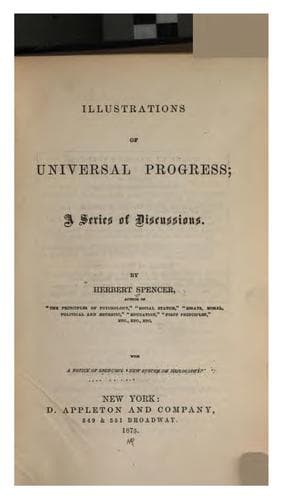
Illustrations of Universal Progress: A Series of DiscussionsSpencer, Herbert
Philosophy
Illustrations of Universal Progress: A Series of Discussions
Spencer, Herbert
Philosophy; Political science; Science
The immediate results of the disturbance would themselves be sufficiently
complex. Besides the numberless dislocations of strata, the ejections of
igneous matter, the propagation of earthquake vibrations thousands of miles
around, the loud explosions, and the escape of gases; there would be the
rush of the Atlantic and Pacific Oceans to supply the vacant space, the
subsequent recoil of enormous waves, which would traverse both these oceans
and produce myriads of changes along their shores, the corresponding
atmospheric waves complicated by the currents surrounding each volcanic
vent, and the electrical discharges with which such disturbances are
accompanied. But these temporary effects would be insignificant compared
with the permanent ones. The complex currents of the Atlantic and Pacific
would be altered in direction and amount. The distribution of heat achieved
by these ocean currents would be different from what it is. The arrangement
of the isothermal lines, not even on the neighbouring continents, but even
throughout Europe, would be changed. The tides would flow differently from
what they do now. There would be more or less modification of the winds in
their periods, strengths, directions, qualities. Rain would fall scarcely
anywhere at the same times and in the same quantities as at present. In
short, the meteorological conditions thousands of miles off, on all sides,
would be more or less revolutionized.
Thus, without taking into account the infinitude of modifications which
these changes of climate would produce upon the flora and fauna, both of
land and sea, the reader will see the immense heterogeneity of the results
wrought out by one force, when that force expends itself upon a previously
complicated area; and he will readily draw the corollary that from the
beginning the complication has advanced at an increasing rate.
Before going on to show how organic progress also depends upon the
universal law that every force produces more than one change, we have to
notice the manifestation of this law in yet another species of inorganic
progress--namely, chemical. The same general causes that have wrought out
the heterogeneity of the Earth, physically considered, have simultaneously
wrought out its chemical heterogeneity. Without dwelling upon the general
fact that the forces which have been increasing the variety and complexity
of geological formations, have, at the same time, been bringing into
contact elements not previously exposed to each other under conditions
favourable to union, and so have been adding to the number of chemical
compounds, let us pass to the more important complications that have
resulted from the cooling of the Earth.
Public-domain text, read in full here on John Shaqi.
Reviews
Reviews
No reviews yet
Be the first to share your thoughts on this work.
Join the Discussion
Join the discussion
Sign in to leave a comment or review.
Sign InorCreate an account