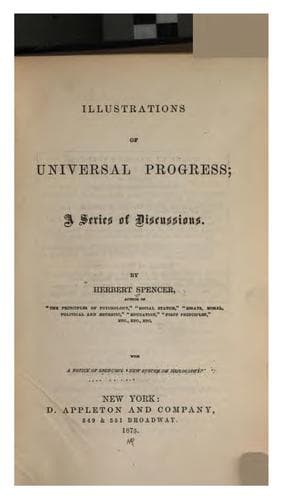
Illustrations of Universal Progress: A Series of DiscussionsSpencer, Herbert
Philosophy
Illustrations of Universal Progress: A Series of Discussions
Spencer, Herbert
Philosophy; Political science; Science
And then when we pass to the compounds of organic chemistry, we find this
general law still further exemplified: we find much greater complexity and
much less stability. An atom of albumen, for instance, consists of 482
ultimate atoms of five different kinds. Fibrine, still more intricate in
constitution, contains in each atom, 298 atoms of carbon, 40 of nitrogen, 2
of sulphur, 228 of hydrogen, and 92 of oxygen--in all, 660 atoms; or, more
strictly speaking--equivalents. And these two substances are so unstable as
to decompose at quite ordinary temperatures; as that to which the outside
of a joint of roast meat is exposed. Thus it is manifest that the present
chemical heterogeneity of the Earth's surface has arisen by degrees, as the
decrease of heat has permitted; and that it has shown itself in three
forms--first, in the multiplication of chemical compounds; second, in the
greater number of different elements contained in the more modern of these
compounds: and third, in the higher and more varied multiples in which
these more numerous elements combine.
To say that this advance in chemical heterogeneity is due to the one cause,
diminution of the Earth's temperature, would be to say too much; for it is
clear that aqueous and atmospheric agencies have been concerned; and,
further, that the affinities of the elements themselves are implied. The
cause has all along been a composite one: the cooling of the Earth having
been simply the most general of the concurrent causes, or assemblage of
conditions. And here, indeed, it may be remarked that in the several
classes of facts already dealt with (excepting, perhaps, the first), and
still more in those with which we shall presently deal, the causes are more
or less compound; as indeed are nearly all causes with which we are
acquainted. Scarcely any change can with logical accuracy be wholly
ascribed to one agency, to the neglect of the permanent or temporary
conditions under which only this agency produces the change. But as it does
not materially affect our argument, we prefer, for simplicity's sake, to
use throughout the popular mode of expression.
Public-domain text, read in full here on John Shaqi.
Reviews
Reviews
No reviews yet
Be the first to share your thoughts on this work.
Join the Discussion
Join the discussion
Sign in to leave a comment or review.
Sign InorCreate an account