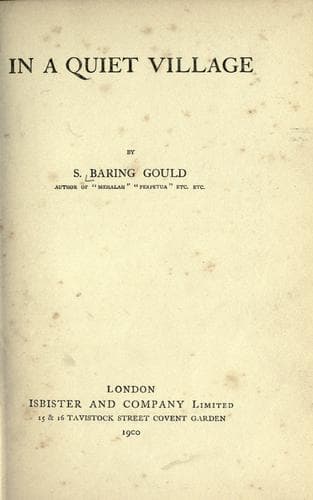
England -- Fiction; Short stories, English; Villages -- Fiction; Wales -- Fiction
One of the Quercy prayers deserves quotation, because it also is akin
to something that was customary in England, the Lykewake Dirge, which
is found in Aubrey’s MS., already quoted, and was first published by
Sir Walter Scott. The Quercy prayer is called “La Barbe-Dieu,” _i.e._
Verbum-Dei; _barbe_ is a corruption. It runs thus:—
“The Barbe of God—who knows it, and says it not, he will lose
his soul. There behind thee lies a plank, a little plank
that’s long, not broad. The elect pass over it. The lost fall
from it and cry and groan, falling into the abyss of hell.
Learn the Barbe of God at seven years old. There is no time for
repentance when parted are body and soul.”
In a book published at Toulouse in 1673 by the Père Amilha, in the
Languedoc patois, entitled “Le Tableau de la bido del parfait Chresten,”
a popular book of Christian instruction in faith and morals, is a caution
against superstitious practices. Among these are the following questions:
“Have you tried to make a denier float on the water, whereby to detect
the thief who has stolen your goods? Have you taken off the cross from
the rosary, and said the Little Pater and the White Pater?”
These prayers, which were supposed to have a power to save from
everlasting death by mere recitation of them, are mentioned by J. B.
Thiers, in his “Treatise on Superstition,” as condemned by the Church;
and he names among them the Barbe de Dieu as heretical.
Quenot, in his “Statistique de la Charente,” in 1818, gives the form in
which the White Paternoster was said in that department of France—
“Dieu l’a fait, je la dit,
J’ai trouvé quatre anges couchés dans mon lit,
Deux à la tête, deux aux pieds,
Et le bon Dieu au milieu.”
The forms in which it is said throughout France are infinitely varied,
but the same ideas reign throughout all, and all derived from a common
source. That source is apparently Albigensian Manichæism. It seems from
the questions put to these heretics that the “Perfect,” the apostle of
the sect, taught a fourfold Paternoster, and taught it as a sort of
charm, with the assertion, which repeatedly occurs in all these folk
rhymed Paters, that they who recited it secured thereby their eternal
salvation.
It is certainly—if this fourfold Albigensian Pater be the origin of
our “Matthew, Mark, Luke, and John”—a very curious instance of the
underground growth of the heresy throughout Europe, and the hold it
obtained on the poor and ignorant.
I give a remarkable instance from Lincolnshire of the glossing over of
pagan usage by Christianity. I was furnished with it by the Rev. R. M.
Heanley, who wrote:—
“THE VICARAGE,
UPTON GREY, WINCHFIELD,
_Nov. 16, 1890_.
Public-domain text, read in full here on John Shaqi.
Reviews
Reviews
No reviews yet
Be the first to share your thoughts on this work.
Elsewhere in the archive
Join the Discussion
Join the discussion
Sign in to leave a comment or review.
Sign InorCreate an account