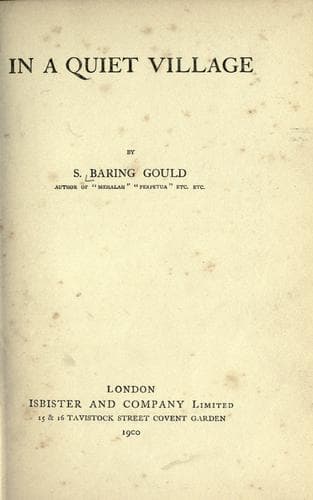
England -- Fiction; Short stories, English; Villages -- Fiction; Wales -- Fiction
But he took, it must be conceded, a very long time over his task. Most
persons who employed him lost patience because he was so slow. But slow
he was not when one considered the quality of his workmanship. He scamped
nothing. When he painted even a railing, he took infinite pains to
holystone the wood till he had cleaned off every particle of old paint
and had got the wood perfectly smooth. And each coat of paint was laid
on with the greatest nicety. There was a carved oak table that once stood
in our drawing-room. The fashion had set in for satin-wood, so the room
was done up, doors, cabinets, tables, all to look like satin-wood. And
all was done by Doble Drewe.
Most lovely make-believe satin-wood he produced. That was before the
days of the “Seven Lamps of Architecture,” when Mr. Ruskin turned his
bull’s-eye on shams, and showed that they were morally wrong. At the
period of which I write everything _must_ be a sham or it was not
fashionable. Wood was painted to look like marble, and cement to imitate
wood.
Well—about this carved table.
The other day I sent it to a furniture-dealer to remove the paint and
develop the oak.
After a while it returned to me, and with it came the bill.
“Really, sir,” said the dealer, “I am ashamed at having asked so much,
but it is incredible what labour it has taken my men to clean that table.
Never saw nothing like it before. The paint simply wouldn’t come off. It
was like taking the skin off a living man.”
“Ah!” said I, “Doble Drewe’s work.”
But if Doble was slow over his tasks, he was slower in sending in his
bills. Why he did not make them out and transmit them to his customers
till three, four, even six years had elapsed, I cannot tell, but it is a
fact. And this lost him customers who could pay, because they did not
relish having to give out money over items every one of which had passed
from their memories. The only customers he gained were those thriftless
creatures who did not want to pay there and then, and who hoped they
might be more flush of money in a few years’ time than they were in the
present. And some of his customers died, others became bankrupt, or left
the neighbourhood without leaving their addresses, before Doble Drewe’s
bills were ready. I know that mine came in for work done for my father
five years after my father was dead, and I had thought all had been
settled, probate paid, with deductions for bills, and Doble’s, of course,
not deducted because I did not know it was due.
Now although scrupulously conscientious over his plumbing and glazing,
his paper-hanging and painting, and though whilst on his work he had all
his faculties engaged upon it, yet Doble had a soul for something very
much above lead and paint and putty.
I found it out one day in this wise.
Public-domain text, read in full here on John Shaqi.
Reviews
Reviews
No reviews yet
Be the first to share your thoughts on this work.
Join the Discussion
Join the discussion
Sign in to leave a comment or review.
Sign InorCreate an account