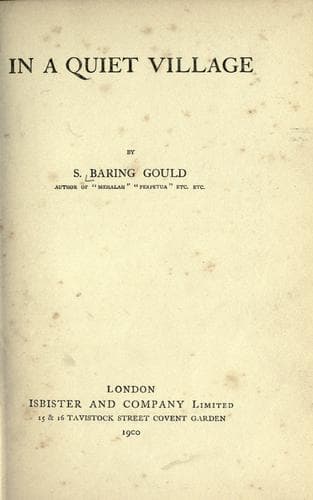
England -- Fiction; Short stories, English; Villages -- Fiction; Wales -- Fiction
My mother had a marvellously lovely voice, and she was sitting in the
drawing-room that had been satin-wooded, at the piano playing and
singing, whilst Drewe was in the hall labouring at painting the panels
to look like pollard willow, stippling, brushing, graining, putting in
plenty of knots where no knots really were, and running the grain across
the direction where its course by nature lay.
I happened to be in another part of the hall to that where was the
painter on his knees engaged at his work. He did not know that I was
there—so quiet was I, engaged on Captain Maryatt’s “Snarley Yow, or the
Dog Fiend.”
If I remember aright my mother was singing Haynes Bayley’s “We met, ’twas
in a crowd.”
It was not a song for a soprano or for a woman, and though she went
through with it, seemed unsatisfied, put the book away and was for a
while engaged in finding another piece.
I thought I heard a sound from the corner where the painter was. I looked
up from “Snarley Yow,” but seeing nothing particular, looked again at the
entrancing book.
Then my mother broke out in the song from the “Creation,” “With verdure
clad.”
Before she had got half-way through I was sure that I heard something
from Doble. It was a sob.
I stood up—but he put back his hand to stay me as I approached.
I waited till my mother’s singing and the chords of the piano had ceased
to vibrate, and then I said to him:
“Are you unwell, Mr. Drewe? Is there anything I can get for you?”
He had a choke in his voice, and I saw as he turned that his cheeks were
wet with tears.
“Excuse me, young gentleman,” said he. “Don’t mind me. I cannot help it.
Indeed, indeed, I cannot refrain. When I hear music, good, beautiful
music, it makes me cry like a woman—like a woman. You’ll excuse me. Go
on with your book and don’t mind me.”
I had many a talk with the plumber after this, and I found that it was
so with him. When he heard good music he passed into a transport, an
ecstasy. But then, how seldom it was that he did hear and could hear good
music! He lived in a little village some ten miles from a town, and that
a sleepy, stagnant country town, and no railway within thirty miles.
Nowadays we have in our little centres all over England good choral
societies, and concerts are given not only by amateurs, that may
sing well, but often only think that they do so, but also by touring
professionals.
It was not so when I was a boy. Then there were no such things as
choral unions and concerts, out of the capital of the county, that was
accessible only by coach.
Then locomotion was not easy; and the utmost length of a villager’s
journey was to the market town and that only on a market day.
At that time the parish church indeed had its orchestra and its choir,
but oh! what appalling, agonising productions were the concerted pieces
there produced.
Public-domain text, read in full here on John Shaqi.
Reviews
Reviews
No reviews yet
Be the first to share your thoughts on this work.
Join the Discussion
Join the discussion
Sign in to leave a comment or review.
Sign InorCreate an account