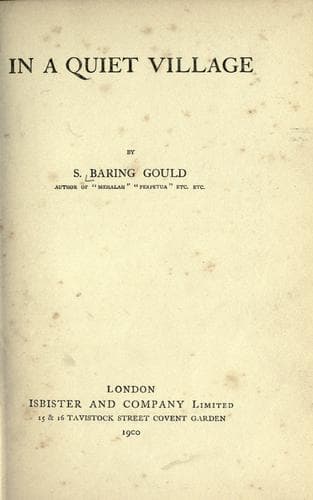
England -- Fiction; Short stories, English; Villages -- Fiction; Wales -- Fiction
When I had got to the bottom of the story, I rushed off to Miss Shank
to explain that the whole thing was a misunderstanding, and ought to be
put aside, and peace made. But the lady was furious; she turned on me as
a mischief-maker and a meddlesome person for having dared to interfere.
She knew that what Miss Spindle meant was to cast slurs at her, and she
employed the mutton-bone as a subterfuge so as to avoid prosecution.
There it was, worse than ever. I was out with one. I went to Miss
Spindle. She was exasperated because Miss Shank had dared to believe that
what she had spoken about the mutton applied to her, and she broke into a
torrent of abuse of me for interfering in the matter.
There it was; I was out with the other.
As I retired disconsolately, I ran across Mary Trembath, and somehow, for
my heart was full, I told her of my ill success.
“Leave it to me,” said Mary.
What was my amazement next Sunday to see Miss Spindle and Miss Shank
embracing in the churchyard after service, and walking off arm-in-arm and
chatting affectionately together!
How had this transformation in the women, this change in the situation,
been brought about? Only with difficulty did I get at the bottom of
it. Mary, whilst selling a hank of coloured wool to Miss Spindle, had
contrived to hint to her that Farmer Shank, the widower, was terribly
concerned over the quarrel, as he was actually much enamoured of the fair
spinster who lived in the bower of laurels.
Then, Mary Trembath had gone to the farm of the Shanks, and had let out
in confidence that Miss Spindle’s conscience so pained her over the
mischief done, that she was sending for the lawyer to alter her will and
make over Laurel Cottage and her few hundreds in the Three per Cents. to
the woman she had so grievously injured.
When I learned this, I thought I would have it out with Mary. She pulled
a face as I reproached her.
“Please, sir, I didn’t say it was so; I merely hinted such a thing might
be. They jumped at the conclusion, and turned what might be into it is
so.”
“But, Mary, it was not true.”
“How do you know that, sir?—all things are possible.”
That was Mary Trembath’s secret way of making smooth water wherever she
went. She was not a deliberate liar, even for a good purpose; but she
managed somehow to create impressions that served to bring quarrels to an
end, to make people once indifferent to each other become fast friends,
and to dispel pretty nearly every cloud that hung over a parish in which
she peddled.
And now you will see how it is that, as I said, she provided me with
a problem only a casuist can solve. Of course, it is never right to
speak an untruth even for a good end. Mary was too conscientious to say
straight out what was false, but she had a clever, subtle manner of
bewildering people through her hints and suggestions, till she induced
them to deceive themselves, and that always with a good object in view.
Public-domain text, read in full here on John Shaqi.
Reviews
Reviews
No reviews yet
Be the first to share your thoughts on this work.
Join the Discussion
Join the discussion
Sign in to leave a comment or review.
Sign InorCreate an account