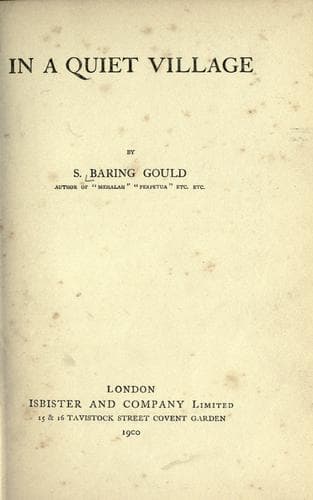
England -- Fiction; Short stories, English; Villages -- Fiction; Wales -- Fiction
She was a peacemaker, eminently a peacemaker, but was she justified in
the method she employed to make peace?
THE OLD POST-BOY
THE OLD POST-BOY
One of the most characteristic and interesting features of old English
life has passed away beyond recall—the post-boy. Whatever his age he was
always a boy, for he always wore the short jacket. His _confrère_ the
postillion has lasted on somewhat longer on the Continent, but he also is
nearly gone. He was a picturesque feature, very different from the dapper
English post-boy.
The latter figures in most old English romances. He took a part in all
elopements, and was concerned in the conveyance of Queen’s Messengers
with despatches; he was suspected of affording information to and
furnishing opportunities for highwaymen.
Who does not remember the flight of Jingle with Miss Rachel, in
“Pickwick,” and the pursuit by Mr. Wardle and Mr. Pickwick?
But the post-boy has taken more than a subsidiary part in a story, he is
the hero in Smollett’s “Humphry Clinker,” and he figures as a leading
part in the opera of “Le Postillon de Longjumeau.” His place now knows
him no more. He is as extinct an animal as the dodo or the great auk.
The last I knew was fallen from his old estate—a slim, grey-haired
man, who drove a hired carriage, but no longer mounted one of a pair of
post-horses. At weddings the post-boy made his final appearance, with a
white beaver hat, a yellow jacket and white breeches and top-boots, a
showy individual, and poor old George Spurle, whom I knew, had appeared
in his proper character on many such occasions before leaving the saddle
altogether to mount the box. His jacket was of a buttercup yellow, but
other colours were indulged in by these servants of the public. Humphry
Clinker wore “a narrow-brimmed hat with gold cording, a cut bob [wig],
a decent blue jacket, leather breeches, and a clean linen shirt, puffed
above the waistband.”
Old George, like every other post-boy I have known, loved his horses. In
his old age he loved them too well, spared them so much as to annoy those
whom he was conveying, and who proved impatient at his walking them up
the least hill, and at his frequent dismounting to ease his brute.
There was a grey mare he was specially fond of, and one night the grey
got her halter twisted about her neck and was found strangled. George
Spurle sat down and fairly cried. The landlord seeing him so cut up
endeavoured to comfort him.
Public-domain text, read in full here on John Shaqi.
Reviews
Reviews
No reviews yet
Be the first to share your thoughts on this work.
Join the Discussion
Join the discussion
Sign in to leave a comment or review.
Sign InorCreate an account