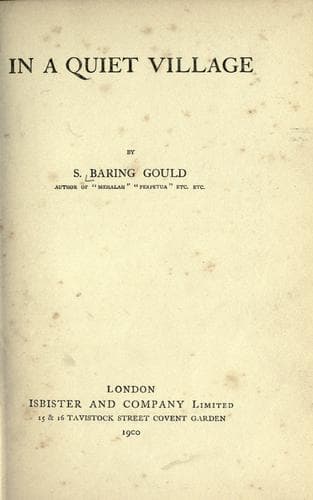
England -- Fiction; Short stories, English; Villages -- Fiction; Wales -- Fiction
Auntie’s gowns were mostly of dark grey, but she had one for the evening
of good silk that was silver-grey, and in that, at night, Auntie looked
quite presentable. But Auntie rarely wore it. She could not dine out, as
she had no carriage or conveyance of any sort, and the risk of marring
her one silk evening dress, by going on foot in such an unsettled climate
as is ours in England to the house where the festive board was spread,
that was too serious to be undertaken. But she did, once, dine in it at
the Hall, without having been fetched. Then she had hired a farmer’s
butter-cart, that in which he sent some of the home produce to market.
It was without springs, it was without seats, and it was _sans_ steps.
The cob that drew it was white and ungroomed, brought in for the occasion
from the field in which it lay and rolled. Auntie’s maid had put a chair
in the cart and a chair beside the cart. By this means the old lady
mounted into it, without the necessity of scrambling up the spokes of the
wheel, or leaping on to the shaft, and thence somersaulting into the cart.
But this conveyance of two wheels so shook up Auntie internally that she
had no appetite for her dinner, and no enjoyment of the social evening.
Mrs. Estcourt, after that, sent the carriage for her, but Auntie could
rarely be prevailed on to accept it. She was poor in pocket and large in
heart, and she tipped the coachman on such occasions half-a-crown, and
half-a-crown to Auntie was a sum of money that she could ill afford to
miss.
No one in the parish, rich or poor, secular or clerical, thought of
calling the old lady by other name than “Auntie,” yet was she aunt to no
single person there, nor indeed remotely connected with any. Those who
wished to be respectful called her Miss Jane, or Miss Auntie. Yet was
there a tie, not of blood, that bound her to all and all to her, a tie
even stronger than that of blood—the tie of infinite charity.
Never was there a woman with a kinder, more unselfish heart than old
Auntie. Her mind was ever active, but occupied only with thought of
others.
Unhappily we know by experience that this world of ours is full of
selfishness, that among a hundred persons we meet, scarce one is
not infected with this vice; nevertheless there is a salt of fresh
unselfishness to be discovered. But among the many of these elect, the
very crown and acme of all was, I verily believe, Auntie.
The parish knew her story, yet no one ventured on an allusion to
it in her hearing, except possibly Mrs. Estcourt, who had been her
schoolfellow, and with whom she did sometimes speak of the past, and open
that old, but unwithered, heart.
The story was this.
Public-domain text, read in full here on John Shaqi.
Reviews
Reviews
No reviews yet
Be the first to share your thoughts on this work.
Join the Discussion
Join the discussion
Sign in to leave a comment or review.
Sign InorCreate an account