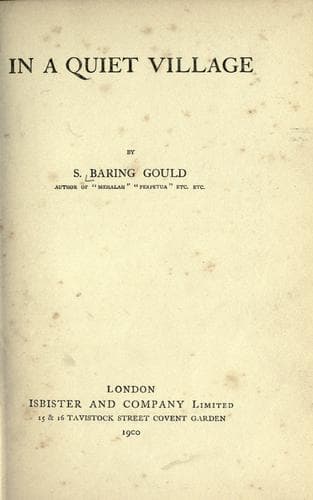
England -- Fiction; Short stories, English; Villages -- Fiction; Wales -- Fiction
The Squire’s wife proceeded at once to attack the old lady on the topic.
Was it true that she was about to place her little fortune in the hands
of this brother-in-law? For if Jane meditated doing this, Mrs. Estcourt
said it would be her painful duty to inform Auntie of certain matters
concerning Mr. Warnacre that in kindness had been kept from her.
Auntie coloured and trembled, and raised her bemittened hands in
deprecation of the interference and the revelation. Then she began to
explain:
“Mr. Warnacre really was a surprisingly clever man. He had met with
misfortunes, he had made enemies, who had not scrupled to blacken his
character. It was too sad to see a man of his ability and acquirements
without an opening in which to display his activity.”
“But, my dear Jane, he has been dishonest!”
“O Maria, we are all guilty of doing wrong sometimes, and I am sure we
ought not to be hard on those who have. Even supposing he has made a
mistake, we ought to give him the helping hand, and put him in a position
where he can make amends.”
“My dear Jane,” said Mrs. Estcourt, and she set her lips. “Excuse me if
I speak unpleasant truths. How do you know, how does Mr. Warnacre know,
that what he proposes to undertake will be successful? There is many a
slip between the cup and the lip. With the very best and most honourable
intentions, he may miscarry. Then what will become of you?”
“Oh, my dear Maria, he is certain to succeed. He has shown it me so very
plainly.”
“He may not. Always be prepared for a _not_.”
“But for his sake I must risk something. He was my dear Emily’s husband,
remember that. And he has had such trials and troubles—he has lost her,
and does not know where poor John is.”
“Jane, it won’t do. Excuse my bluntness. Suppose the whole thing fails.
Where would you be? If your little income is gone, then you will
be penniless in your old age. Now that means—” Mrs. Estcourt moved
uncomfortably in her chair. She was going to say a harsh thing, but did
it only because she believed that nothing else could save Auntie. “That
means, Jane, that you will come upon me. I will not see you turned out of
your cottage to starve. When all your income is gone, I shall have to
furnish you with an annuity. Now, mind, I should not object to that, if
the result of an accident, a bad investment, or failure of a bank. But
that you should deliberately and with your eyes open throw this upon me
is not fair; no, it is not fair to me.”
Poor little Auntie crimsoned to her temples. She tried to speak, but
could not. Then she broke down, covered her face with her kerchief and
wept. Mrs. Estcourt held to her point.
“I have promised it him,” sobbed Auntie.
“You may, if you will, give him something. But I insist—I insist for my
own sake as well as for yours—that you do not give him all. Reserve to
yourself so much as you can live on. Say, keep as much as was expended
on yourself when you were sending that boy to school. That alone will
satisfy me.”
Public-domain text, read in full here on John Shaqi.
Reviews
Reviews
No reviews yet
Be the first to share your thoughts on this work.
Join the Discussion
Join the discussion
Sign in to leave a comment or review.
Sign InorCreate an account