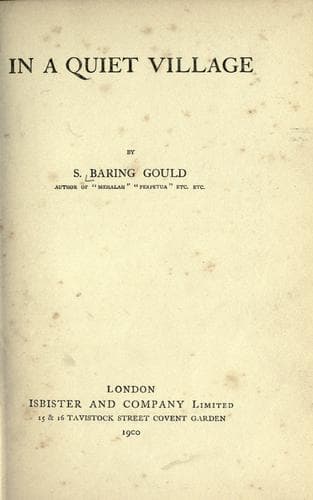
England -- Fiction; Short stories, English; Villages -- Fiction; Wales -- Fiction
At length Mrs. Estcourt carried her point. She extorted a solemn
reluctant promise to that effect from the old lady, and that she would
not go beyond her word Mrs. Estcourt knew very surely.
And well was it for the little Auntie that this interview had taken
place, for within a twelvemonth all she had given to Mr. Warnacre was
gone, and gone without return of interest or principal. With it also Mr.
Warnacre had disappeared. Then she lived on, in the same house, on her
shrunken means, doing good to all around—knitting crossovers for old
women, making mittens for children, warm woollen caps and mufflers that
she sent to the engine-drivers on the line to keep them comfortable on
a winter’s night, busy before Christmas in contriving presents for all
around, forgetful of no birthday, visiting and sitting with the sick and
aged, and although her gifts were never costly, yet they were always
valued highly by the recipients, for the love and kindly thought that was
worked into them. She manufactured little book-markers, with crosses on
them, of perforated card; she did embroidery for the church; she painted
little pin-cushions, and her flower-painting was tasteful. These she was
glad to sell, and Mrs. Estcourt came to her assistance and disposed of an
astonishing number at sixpence each. They were so useful for gentlemen,
would go into a breast pocket, and gentlemen were always wanting pins.
But Auntie would use none of the money thus acquired upon herself; it
was spent in the purchase of material for making her little gifts to the
poor, or for the church.
The parson had his daily service, but the most constant of his
congregation, certainly in the mornings, was Auntie, who never failed.
Mrs. Estcourt brought visitors from the Hall to see her, not such as
were unable to appreciate the goodness and sweetness of the old lady,
but kindly-hearted ladies and gentlemen, and somehow these visitors
afterwards in town, or wherever else they met the Squire, always inquired
after Auntie. They felt they were the better for having seen and spoken
with her.
To some it was a revelation that there were, in this self-seeking and
somewhat coarse world, some highly-refined, unselfish spirits, the
violets of the moral world.
As already said, every one in the place knew her story, but to her face
no one alluded to it. Among the English peasantry there is a wonderful
and beautiful delicacy of feeling such as often puts to shame those who
belong to highly-cultured grades. The utmost done was to ask, “Please,
miss, have you heard anything of Master John?”
Then a quiver would pass over the old face, the lip would tremble, and
the eye fall, and she would shake her head, unable to give the denial in
words.
Public-domain text, read in full here on John Shaqi.
Reviews
Reviews
No reviews yet
Be the first to share your thoughts on this work.
Join the Discussion
Join the discussion
Sign in to leave a comment or review.
Sign InorCreate an account