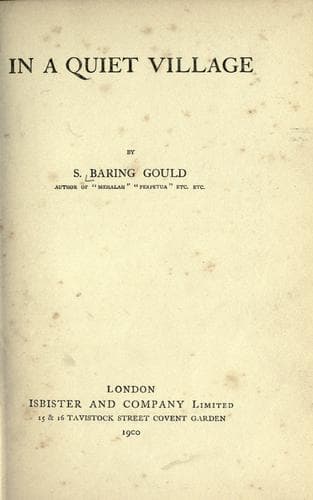
England -- Fiction; Short stories, English; Villages -- Fiction; Wales -- Fiction
Often and often did Mrs. Estcourt send to her grapes or peaches or
melons from the conservatories at the Hall, and yet she knew that most
of these good things were at once distributed by the old lady among the
children as they swarmed out of school, or given to some sick body with a
capricious appetite.
The farmers also or their wives sent her poultry, the children picked for
her watercress, the poor women gave her eggs, and then Auntie had no rest
until she had proclaimed to the parson and his wife, to the squiress, to
all she knew, how good and generous these poor bodies had been to her.
And every day she sat at her window painting her pin-cushions or making
the little crosses for book-markers, or setting them up on little card
stands, or illuminating texts, and nodding and smiling to all passers-by
in the road, and to the children as they came to school. Between school
hours in wet weather many a little girl found a refuge in Auntie’s
kitchen, there to eat her dinner and have warm milk or tea.
It was a sad prospect to Auntie when her sight began to fail. Resigned
to the will of Heaven she ever was, but she regretted the inability into
which she would fall of manufacturing comforting articles for the poor.
So years passed.
Nothing was heard of Warnacre, nothing of John. No word of reproach
passed her lips. I believe no resentful thought arose in her mind against
her brother-in-law, and I am sure that both he and John were daily
mentioned in her prayers.
Then, one stormy evening, a knock came at the door, and she heard some
one coughing without. The little maid opened, and a wretched, wet, and
draggled man staggered in. It was Warnacre, returned, but returned
destitute, a wreck in health, and a beggar.
The little maid who had gone to the door at the rap was frightened, and
thought that the man was drunk; she had never seen Mr. Warnacre, and her
exclamations of distress and alarm brought the old lady to the passage.
Warnacre had thrown himself into a chair, the rain had sodden his
battered hat, and his shapeless and napless greatcoat, and ran over the
floor. The man was grey in face, his scanty hair dishevelled, and his
eyes dull and sunk in his head.
A fit of coughing prevented him from speaking.
“Oh, please, miss, what shall we do? It’s a tipsy, it is. Shall I run for
the police?”
“No, Kate, no, the gentleman is ill.” Auntie had not as yet recognised
him, but she brought the light near, and with an exclamation of pain and
surprise cried, “O William! William! you here again?”
“What,” said he, “are you like the rest, ready to turn against me? It is
a bad and selfish world; no one has a hand to hold out for a fellow who
is down on his luck. I’ve walked——”
Again the cough overtook him, and he put a soiled handkerchief to his
mouth.
Public-domain text, read in full here on John Shaqi.
Reviews
Reviews
No reviews yet
Be the first to share your thoughts on this work.
Join the Discussion
Join the discussion
Sign in to leave a comment or review.
Sign InorCreate an account